iPhone 5s Carries $199 BOM and Manufacturing Cost
Apple?s new flagship iPhone 5s device features cutting-edge components that represent pioneering achievements for the smartphone market while maintaining a nearly identical cost compared to the iPhone 5.
The low-end version of the iPhone 5s with 16 gigabytes (GB) of NAND flash memory has a bill of materials (BOM) of $191, according to the preliminary results of a physical dissection of the device conducted by the Teardown Analysis Service at IHS. When the $8 manufacturing expense is added in, the cost rises to $199. The compares to a $197 total cost for the original iPhone 5, based on the completed IHS teardown analysis from one year ago.

"The iPhone 5s features a 64-bit apps processor, low-power Double Data Rate 3 (LPDDR3) DRAM, and a novel fingerprint sensor—features that have never before been seen in a smartphone," said Andrew Rassweiler, senior director, cost benchmarking services for IHS. "In addition, it is very interesting to see that Apple continues to collaborate closely with suppliers to develop unique radio frequency (RF) solutions that give Apple a competitive edge."
The table below presents the preliminary BOM and manufacturing cost based on a physical dissection of the iPhone 5s conducted by the IHS Teardown Analysis Service. Note that the teardown assessment is preliminary in nature, accounts only for hardware and manufacturing costs and does not include other expenses such as software, licensing, royalties or other expenditures.

Although other smartphones have included 64-bit graphics processors, the 5s is the first model with a 64-bit applications processor. "The move to the 64-bit apps processor is largely driven by the need for greater computational power to ensure that the smartphone’s fingerprint sensor works quickly and seamlessly," said Wayne Lam, senior analyst for wireless communications at IHS. "The processor also boosts the performance of the iPhone 5s’s camera, allowing 120 frame-per-second (FPS) video and 10 FPS photo capture. This design change will likely set the stage for 64-bit processors to be used in upcoming Apple products, including new models of the iPad, the Apple TV and even MacBook Air PCs."
The 64-bit processor is part of the Apple-designed A7 apps processor, based on a core from ARM Holdings plc. The new 64-bit processor core is called "Cyclone," as opposed to the 32-bit version used in the iPhone 5 and 5c, known as "Swift." Despite the well-publicized feud between the companies, Samsung is the manufacturer of Apple’s A7 (28nm). This likely is because Samsung has a license to ARM's 64-bit core. The A7 used in the iPhone 5s costs $19 - significantly higher than the A6 used in the original iPhone 5 and 5c, which currently carries a cost of $13.
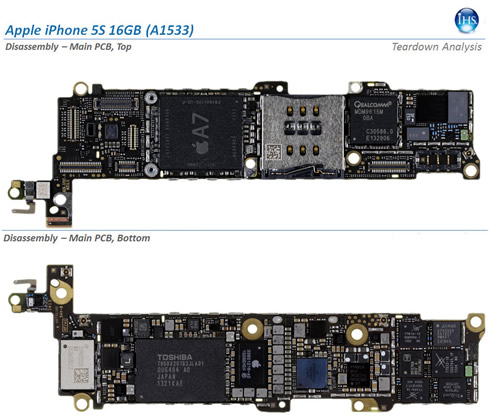
In parallel with the upgrade to 64-bit computing, Apple has updated the memory of iPhone 5s to LPDDR3, marking the first time that the IHS Teardown Analysis Service has identified this advanced type of DRAM in an electronic product. Apple probably used this high-speed, cutting-edge memory - as opposed to the LPDDR2 employed in the original iPhone 5 and 5c - to support the fast processing speeds of the A7. Such performance comes at a price. The 1 GB of LPDDR3 costs $11.00, up from $9.50 for the same quantity of LPDDR2 in the 5c.
The addition of the fingerprint scanner also represents an increased hardware cost for the 5s. The user-interface segment of the 5s, which includes the fingerprint scanner, costs $15. This compares to just $8 for the user interface for the 5c, which has no fingerprint scanner.
Another major difference between the iPhone 5s and the original iPhone 5 lies in the RF transceiver, which has been updated to support more 4G Long Term Evolution (LTE) bands. Like the iPhone 5c, the 5s uses Qualcomm’s WTR1605L RF Transceiver, which supports up to seven simultaneous LTE connections during operations. The original iPhone 5 utilizes the older RTR8600L RF transceiver, also from Qualcomm, which supported only five active LTE bands.
One of the biggest-ticket items in the iPhone 5s gets no change: the display and touch-screen subsystem. Maintaining the same specification and the same suppliers for the panels as the iPhone 5 has helped Apple hold the line on its hardware costs for the 5s. Japan Display Inc., LG Display and Sharp have been the main display suppliers for the iPhone 5 for more than a year, allowing Apple to provide them the opportunity to enhance their manufacturing yields and efficiencies. NAND flash has also not made any significant advances with the 5s, and the amount of the memory content in the phone remains the same.
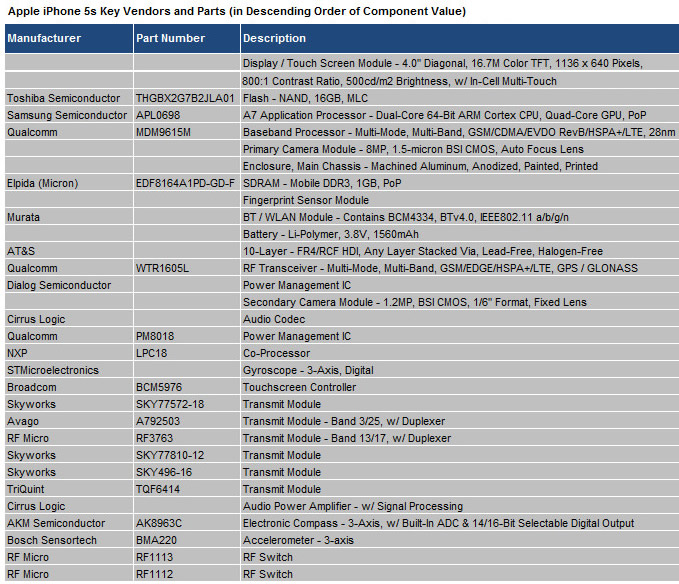
The table below presents major component suppliers for the iPhone 5s.
The combined BOM and manufacturing cost for the midrange iPhone 5s with 32 GB of NAND flash is estimated at $208. The 64-GB model’s cost totals $218.