
A Closer Look At Microsoft HoloLens
This week, at the Microsoft Build Developer Conference, Microsoft showed some of the progress it has made since it first introduced Microsoft HoloLens to the world. The company demonstrated a number of new scenarios, made possible through HoloLens powered by Windows 10. Among other things, Microsoft announced that for the very first time, it would provide an opportunity for dvelopers at Build to experience the new hardware.
Microsoft's vision for holographic computing is to transform the world with holograms – connecting the digital world with real life. "With the ability to design and shape holograms, you will have a new medium to express your creativity, a more efficient way to teach and learn, and a more effective way to visualize your work and share ideas," says Todd Holmdahl, who leads Microsoft’s next generation devices team.
Holographic experiences are made possible across a world of devices through Windows 10, including HoloLens - a fully untethered holographic computer running Windows 10, because holograms are Windows universal apps, and all Windows universal apps can be made to work as holograms.
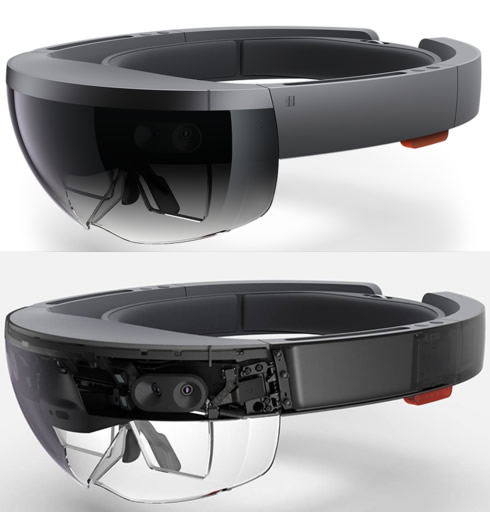
While a variety of specialized components make up HoloLens, it’s the way in which they are combined that makes the whole system seem like science fiction. Like the way the optical system works in lock-step with the advanced sensors, or the way the holographic processing unit makes light work of large amounts of data per second.
They all work together to enable holographic computing natively with no markers, no external cameras, no wires, no phone required, and no connection to a PC needed – doing a whole host of things that are in reality very difficult and technically complex – turning what was once science fiction into science fact.
HoloLens is a collaboration between industrial designers, human factors experts, and engineering teams, and is designed like a performance car with great weight distribution for the most comfortable fit possible.
The device weighs less than the average laptop, while at the same time containing significantly more computing power. And, to accommodate a large number of customers, HoloLens is designed to adjust to fit a wide range of head sizes and shapes while also accommodating most eyewear, without putting any undue pressure on your ears or nose.
HoloLens’ see-through holographic high-definition lenses enable you to see holograms right in your world, right in your lives. Employing an advanced optical projection system, the see-through lenses generate multi-dimensional full-color images with very low-latency so you can see holographic objects in the physical world.
Unlike typical VR systems, where the physical world is completely occluded, the see through lenses allow you to continue to see much of the world around you.
HoloLens has also spatial sound so you can hear holograms even when they’re behind you. Using a scientific model that characterizes how the human ear receives sound from a specific physical location, HoloLens can synthesize a binaural sound so that you perceive it to come from a specific location in the physical space around you. There’s also a microphone array which is used to capture your voice commands, a depth sensor that is used to spatially map your environment and interpret your hand gestures, and a photo/video camera so you can share what you’re doing with others.
The sensors in HoloLens capture information about what you’re doing and the environment you’re in. This is done through the inertial measurement unit (IMU) which includes an accelerometer, gyroscope, and magnetometer. It’s this IMU, coupled with head tracking cameras, which enables HoloLens to understand where your head is and how it’s moving.
In addition to the IMU, HoloLens comes with a CPU and GPU. But that wasn’t enough to handle all the processing required to understand our world, so Microsoft had to go beyond the traditional CPU and GPU.
The company invented a Holographic Processing Unit (HPU). This third processor gives HoloLens the real-time ability to understand where you’re looking, to understand your gestures, and to spatially map the world around you.
This custom silicon efficiently processes data from the sensors, resulting in a relatively simple yet informative output that can be easily used by developers.