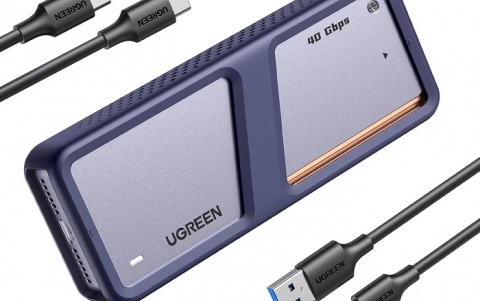
Ugreen CM642 USB4.0 Enclosure
4. macOS compatibility
Review Pages
There are reports around the Internet that users have big issues with the Ugreen CM642 and macOS systems. A user reported that with the Apple M2 Max MacBook Pro (macOS Sonoma 14.4/14.4.1), UGREEN CM642, Lexar NM790 4TB NVMe SSD, the drive kept disconnecting from macOS without a proper eject during read/write operations.
The user methodically ruled out temperature/cooling, SSD compatibility, insufficient Thunderbolt 4 power, a Sonoma-version-specific bug, and a defective unit — before finding, via a separate tech blogger's post, that flashing newer ASM2464PD firmware (from shipped version 231005 up to then-latest 240129 via Station-Drivers) resolved it
48 hours of continuous connection with no disconnects, and similar benchmark numbers before and after. This is the same procedure and branding side-effect (device renaming from "Ugreen Storage Device" to generic "246x") already documented earlier in this review.
Other users said that that the included "certified" 40Gbps/Thunderbolt cable, caused more disconnects than shorter or lower-spec cables — one user's testing showed a 20Gbps cable "almost never" faulted, a 10Gbps or slower cable "never" faulted, but their 40Gbps cabley caused errors. Users reported that using other branded-certified USB4 cable, or a different-brand Thunderbolt cable, resolved disconnects that firmware alone hadn't fixed. USB-C cables rated for high data speeds contain small logic controller chips inside the plugs to negotiate orientation/mode correctly, and suspects the bundled cables have "inadequate or buggy logic," possibly reused from UGREEN's older non-USB4 enclosure lines
Other user systematically tried multiple firmware versions: the "latest" 250717_85_00_00 made disconnects worse than the original shipped 2308 firmware; 241129 was stable but the drive was detected only as USB 3.2 (not full USB4/Thunderbolt); ultimately 250417 was the version that worked best — full USB4/TBT detection on both macOS and Windows, stable, only slightly slower than stock
Others found the older 240129 firmware was the only one that worked for them, while every 25xxxx-series (2025) firmware caused disconnects on their specific hardware
One user reported 250717_85_00_00 (the version tested in this review) did not fix their disconnection problem on a same-chipset UGREEN 55316 enclosure — UGREEN's own support had recommended that exact firmware version, but a cable swap ultimately fixed it instead.
One user disassembled their enclosure and found the internal retention peg holding the SSD in the M.2 socket is soft rubber that may flex under heat, potentially pushing the drive slightly out of its socket and causing intermittent physical disconnection — a mechanical explanation distinct from any firmware or protocol issue
Another user's fix was a genuine hardware modification: adding a slim copper heatsink with thermal paste directly onto the ASM2464PD chip (not just the stock thermal pad, which one commenter noted is aimed at cooling the SSD, not the bridge chip itself) — reporting stable operation afterward with no more disconnects
The BSOD issue is independently corroborated: one commenter wrote "I cannot for the life of me understand why my laptop bsods when I run the program" — matching the manufacturer-documented Windows 11 BSOD issue covered earlier in this review.
Not everyone succeeds, and some simply return the product: several users reported the firmware fix "didn't work" even after multiple attempts, and at least two explicitly gave up and switched to a different brand (Satechi was mentioned as working reliably "right from the beginning," using the same ASM2464PD chipset but apparently better cable/thermal engineering).
Suspected root-cause hierarchy
No single cause explains every report — the evidence points to several independent, stacking variables rather than one bug with one fix:
- Tier 1 (most likely primary cause): firmware version compatibility/regressions, and cable signal integrity at sustained 40Gbps — these two show up most consistently as what actually changed outcomes for individual users
- Tier 2 (contributing factors): host-side USB4/Thunderbolt controller implementation differences (Mac vs. PC, chipset generation), OS-level driver/power-state behavior, and enclosure thermal design
- Tier 3 (unit-specific factors): individual manufacturing variance, fan control tuning, and physical SSD-seating problems
A useful diagnostic habit this reordering suggests: don't just check whether the drive stays connected — check what link mode it actually negotiated (full USB4/40Gbps vs. a silent fallback to PCIe Gen3, USB 3.2, or even USB 2.0). A drive that "works" but has silently fallen back to a slower mode can look deceptively stable while masking the real problem.
What this means for you?
This is not a simple, solved problem — it's an ongoing, multi-year pattern affecting the wider ASM2464PD enclosure category (also reported on Orico, Hagibis, Qwiizlab, HyperDrive, and Satechi-competitor enclosures using the same chip), where the actual fix for any individual user could be: a firmware update (and which specific version varies unpredictably), a better or shorter cable, better cooling (including physical modification), or in some cases nothing short of returning the unit. If you experience mysterious disconnections on macOS with this enclosure:
- Try the official 250717_85_00_00 firmware first (UGREEN's own recommended fix)
- If that doesn't help, don't assume newer firmware is always better — trying a slightly older version (e.g., 241129 or 240129) has worked for multiple users when the latest didn't
- Swap your cable — several users found this mattered more than firmware, and paradoxically a shorter or lower-spec-rated cable sometimes outperformed premium 40Gbps/Thunderbolt cables
- Confirm the actual negotiated link speed/mode after any change, not just whether the drive stays mounted — a silent fallback to USB 3.2 or slower can look like "it's fixed" while masking an unresolved USB4 negotiation problem
- If disconnects are frequent and rapid rather than occasional, check that the SSD is fully seated — a loose seating in the slot has been reported as a physical cause
- If none of the above helps after reasonable effort, this thread's pattern suggests unit-to-unit and even chipset-family-wide variability may mean a different enclosure brand is the more reliable fix
Some users report the enclosure running very hot — some describing it as too hot to comfortably handle — occasionally correlating with random disconnects under sustained load. Other report the fan runs in short, repeated bursts (some describe a 10-seconds-on/10-seconds-off cycle) that is audible but doesn't seem to meaningfully lower temperatures — several suspect the fan is more of a placebo than an effective cooling solution on their specific units. A user noticed that the UGREEN's copper contact plate and thicker thermal pad made direct contact with the SSD, keeping temperatures in the 92–108°F range under a 10-minute sustained stress test — meaningfully cooler than the Acasis (120–162°F) — suggesting thermal performance may vary significantly by unit, drive fit, or how well the thermal pad seats during installation. So its advised to use a thicker thermal pad (2.5–3mm) to ensure better contact between the SSD and the enclosure's internal heat spreader, since the stock pad doesn't always make full contact depending on the specific SSD's height/component layout.
The M.2 mounting screw is a single-piece capture screw+standoff — not obvious from the instructions
A distinctly different, purely mechanical (not electrical) complaint pattern: several buyers report confusion installing the SSD, incorrectly assuming a missing standoff or part, when in fact the retention screw is a single-piece design combining the screw and standoff, with a notch that must be positioned against the SSD's edge before the drive is lowered into place and the screw tightened. Getting this wrong can leave the drive sitting at an angle, unable to seat the screw properly. UGREEN's printed instructions apparently don't make this clear. The fix: position the notch in the screw against the SSD's contact-edge cutout first, then lower the drive down before tightening — not simply insert-drive-then-screw-down as the diagram implies.
Double-sided/thicker NVMe drives may not fit
Double-sided, higher-capacity drives (e.g., WD_BLACK SN850X 4TB) maybe find that the included screw is too short to properly secure the drive, a limitation not mentioned in the box's documentation or (at the time) the product listing. A workaround is to use a longer screw from UGREEN's own 80Gbps Thunderbolt 5 enclosure model or buy one if you can.
Older Mac / Thunderbolt-3-only hosts: a real, specific compatibility gap
Users reported that the ASM2464PD is a USB4 chip, not a genuine Thunderbolt controller, and hosts with only Thunderbolt 3 (not USB4) — including M1-generation Macs and some Intel Titan-Ridge-based Thunderbolt 3 PCs — reportedly cannot use it at full speed or, in some reports, cannot detect it as a Thunderbolt device at all, forcing a fallback to USB 3.x speeds (~10Gbps or lower) or in some cases no connection at all. On Linux, Thunderbolt mode simply doesn't work and must be manually disabled to force USB3 fallback. This lines up with UGREEN's own product marketing listing "Thunderbolt 3/4/USB4/3.2/3.1" compatibility — technically true via fallback, but buyers on older Thunderbolt-3-only hardware should expect USB 3.x speeds, not 40Gbps, and shouldn't assume "Thunderbolt" branding guarantees full-speed operation on any Thunderbolt-labeled port.
Review Pages