
Imec and NUS to Collaborate on Chip-based Quantum Cryptography
Research hub in nanoelectronics and digital technologies Imec and the National University of Singapore (NUS) signed a research collaboration agreement to develop chip-based prototypes for secure quantum communication networks.
In the frame of this five-year agreement, imec and NUS plan to will jointly develop "scalable and efficient technologies" for quantum key distribution and quantum random number generation, which are amongst the basic building blocks of a truly secure Quantum Internet.
Research in quantum information science has indicated that large-scale quantum computers (when realized) will render most of today’s encryption techniques insecure. Although one might argue that such a large-scale quantum computer is still some time away, the situation is nevertheless an urgent one. To that end, two broad directions have been pursued globally, namely a software-based approach called post-quantum cryptography and a hardware-based approach called quantum cryptography.
Post-quantum cryptography is essentially about updating existing cryptographic algorithms and standards so that current infrastructures would be ready for a post-quantum digital world. It however maintains a security profile that is still based on unproven assumptions. Quantum cryptography, on the other hand, offers a much stronger security guarantee: its security is solely based on the laws of quantum physics and thus is in principle unbreakable.
Hence, with regards to critical information infrastructures with long-term security needs such as healthcare, government and banking, quantum cryptography is the safer way to go. With this approach, two essential building blocks are quantum key distribution (QKD) and quantum random number generation (QRNG). At present, however, the methods and processes enabling these quantum technologies are limiting and expensive. Consequently, these bottlenecks have made quantum cryptography unattractive for wide-spread deployment.
Together, imec and NUS aim to resolve some of these bottlenecks. The overarching objective is to move QKD and QRNG technologies to a platform which is much more scalable, robust, and cost-effective. The research collaboration is supported by the National Research Foundation Singapore under the Quantum Engineering Programme.
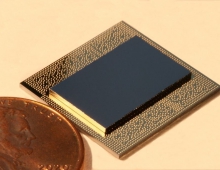
“Our approach consists of developing and integrating all QKD key components in a single silicon-photonics based chip, which ensures a cost-effective solution,” says Joris Van Campenhout, R&D Program director at imec. “As a first deliverable, we will jointly develop an ultrafast quantum random number generation (QRNG) chip, a key component for generating the secret keys. Secondly, we will work on a compact, fully-integrated photonic quantum transmitter prototype chip. In these efforts, we will strongly leverage imec’s deep expertise in silicon photonics technology, originally developed for conventional datacom and telecom applications.”