
New Optical Transmission Technology Achieves 100 Gbps Using 10 Gbps Transmission Components
Fujitsu has developed the first optical-transmission technology that can achieve 100 Gbps transmission speeds using conventional components intended for 10 Gbps networking.
Increasing data-transfer rates has typically required new components designed for those higher speeds, for which existing components have not been compatible. Moreover, there is a limit to the speed improvements that can be achieved with transmission methods using the simple modulation and demodulation formats that have been used to date. Fujitsu Laboratories and Fujitsu R&D Center have applied a Discrete Multi-Tone (DMT) modulation/demodulation format using digital signal processing (DSP) to transmit at 100 Gbps per channel using conventional components intended for transmission speeds of 10 Gbps per channel.
Applying this technology to an optical transceiver with four channels would result in a 400 Gbps Ethernet transceiver, which are needed in the next generation of datacenters in order to increase their data transmission speeds and processing capacity to better support cloud services.
While the DMT modulation/demodulation format is used in xDSL, this is the first time it has been used for optical transmissions at 100 Gbps. DMT divides the data into multiple subcarriers (carrier waves), and multi-level modulation is used for each subcarrier to achieve high transmission speeds. To optimize each subcarrier's power and number of multiple values, an algorithm was developed that checks receiving conditions between optical transceivers at the time the system is started up and optimizes power and the number of multiple values to suit the transceivers and line conditions.
Fujitsu Laboratories and Fujitsu R&D Center have developed a technology that uses existing commodity parts to achieve DMT modulation/demodulation. For example, some components have the characteristic of not being able to maintain sufficient linearity. These components can be profiled in advance and compensated for, enabling them to be used in the same way as parts that do maintain linearity.
Applying this technology to an optical transceiver with four channels would result in 400 Gbps Ethernet transceivers, which are needed in the next generation of datacenters.
With an eye toward practical use of this technology, Fujitsu considers developing an integrated DMT modem, and additional improvements for using existing technologies.
Details of this technology will be presented at the Optical Fiber Communication Conference and National Fiber Optic Engineers Conference (OFC/NFOEC 2013), beginning March 17 in Anaheim, California.
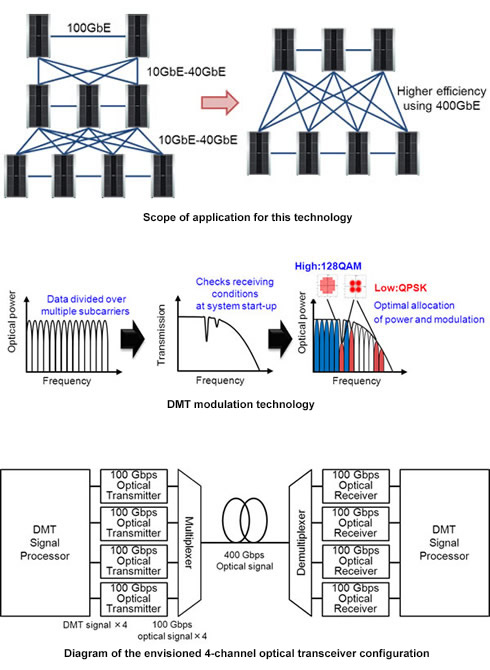
Applying this technology to an optical transceiver with four channels would result in a 400 Gbps Ethernet transceiver, which are needed in the next generation of datacenters in order to increase their data transmission speeds and processing capacity to better support cloud services.
While the DMT modulation/demodulation format is used in xDSL, this is the first time it has been used for optical transmissions at 100 Gbps. DMT divides the data into multiple subcarriers (carrier waves), and multi-level modulation is used for each subcarrier to achieve high transmission speeds. To optimize each subcarrier's power and number of multiple values, an algorithm was developed that checks receiving conditions between optical transceivers at the time the system is started up and optimizes power and the number of multiple values to suit the transceivers and line conditions.
Fujitsu Laboratories and Fujitsu R&D Center have developed a technology that uses existing commodity parts to achieve DMT modulation/demodulation. For example, some components have the characteristic of not being able to maintain sufficient linearity. These components can be profiled in advance and compensated for, enabling them to be used in the same way as parts that do maintain linearity.
Applying this technology to an optical transceiver with four channels would result in 400 Gbps Ethernet transceivers, which are needed in the next generation of datacenters.
With an eye toward practical use of this technology, Fujitsu considers developing an integrated DMT modem, and additional improvements for using existing technologies.
Details of this technology will be presented at the Optical Fiber Communication Conference and National Fiber Optic Engineers Conference (OFC/NFOEC 2013), beginning March 17 in Anaheim, California.