
Intel's Silicon Laser Could Enable Tera-scale Computing
Intel claims a breakthrough in Silicon Photonics research, with the presentation of a laser modulator that encodes optical data at 40 billion bits per second.
Intel's researchers believe that optical modulators can be used to transmit data between the components on a motherboard. The optical lines would operate at higher speeds and require less power than current copper wire lines. The speed increase could allow Intel to create chips that optically transmit one terabit of data every second.
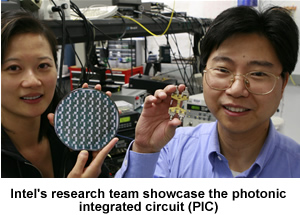
Photonic integrated circuits (PIC) on silicon platforms have attracted particular interest because of silicon?s low cost and high volume manufacturability. Competition in this arena is intense as many players in both academia and industry have been aggressively pursuing research into completely integrated CMOS photonics.
 One of the key components needed for silicon PICs is the high-speed silicon optical modulator, which is used to encode data on optical beam. Today?s commercially available optical modulators at 10 Gbps are based on more exotic electro-optic materials such as lithium niobate and III-V compound semiconductors. These devices have deployed at speeds up to 40 Gbps. Intel's goal to achieve similar performance in silicon has been very challenging, because crystalline silicon does not exhibit the linear electro-optic (Pockels) effect used to modulate light in these materials. Engineers are forced to rely on the free-carrier plasma dispersion effect, in which silicon?s refractive index is changed when the density of free carriers (electrons/holes) is varied, to modulate light in silicon.
In 2004, Intel published in Nature the first silicon modular to reach gigahertz speeds, 50x times faster than previous attempts in silicon. Since then, the company scaled the device to 10Gbps, brining silicon modulation speed to a level comparable to most commercial devices. In January 2007, Intel designed and fabricated a new type of silicon optical modulator scalable to >>10 Gbps and demonstrated data transmission at 30 Gbps. The modulator still relies on the free-carrier effect, but its high speed is the result of a unique device design with traveling-wave drive scheme.
In the conference of Integrated Photonics and Nanophotonics Research and Applications, Salt Lake City, Utah, July 9-11, 2007, Intel's researchers presented a world record results in a silicon modulator to a small group of scientists. "We have finally reached the goal of data transmission at 40 Gbps speed, matching the fastest devices deployed today using other materials," the researchers said.
"With the demonstration of the 40 Gbps silicon modulator and the electrically pumped hybrid silicon laser, it will become possible to integrate multiple devices on a single chip that can transmit terabits of aggregate data per second in the near future ? truly enabling tera-scale computing," the researchers concluded.
Photonic integrated circuits (PIC) on silicon platforms have attracted particular interest because of silicon?s low cost and high volume manufacturability. Competition in this arena is intense as many players in both academia and industry have been aggressively pursuing research into completely integrated CMOS photonics.
One of the key components needed for silicon PICs is the high-speed silicon optical modulator, which is used to encode data on optical beam. Today?s commercially available optical modulators at 10 Gbps are based on more exotic electro-optic materials such as lithium niobate and III-V compound semiconductors. These devices have deployed at speeds up to 40 Gbps. Intel's goal to achieve similar performance in silicon has been very challenging, because crystalline silicon does not exhibit the linear electro-optic (Pockels) effect used to modulate light in these materials. Engineers are forced to rely on the free-carrier plasma dispersion effect, in which silicon?s refractive index is changed when the density of free carriers (electrons/holes) is varied, to modulate light in silicon.
In 2004, Intel published in Nature the first silicon modular to reach gigahertz speeds, 50x times faster than previous attempts in silicon. Since then, the company scaled the device to 10Gbps, brining silicon modulation speed to a level comparable to most commercial devices. In January 2007, Intel designed and fabricated a new type of silicon optical modulator scalable to >>10 Gbps and demonstrated data transmission at 30 Gbps. The modulator still relies on the free-carrier effect, but its high speed is the result of a unique device design with traveling-wave drive scheme.
In the conference of Integrated Photonics and Nanophotonics Research and Applications, Salt Lake City, Utah, July 9-11, 2007, Intel's researchers presented a world record results in a silicon modulator to a small group of scientists. "We have finally reached the goal of data transmission at 40 Gbps speed, matching the fastest devices deployed today using other materials," the researchers said.
"With the demonstration of the 40 Gbps silicon modulator and the electrically pumped hybrid silicon laser, it will become possible to integrate multiple devices on a single chip that can transmit terabits of aggregate data per second in the near future ? truly enabling tera-scale computing," the researchers concluded.