
Breaking News

G.SKILL Showcases DDR5-9200 1.1V 16GBx2 High-Speed CU-DIMM Memory Kit Sony Introduces BRAVIA 9 II and BRAVIA 7 II RGB TVs and the BRAVIA Theatre Trio Creative Announces Sound Blaster AE-X Acer Expands Gaming Portfolio With Predator Atlas 8 Handheld Powered by Intel COLORFUL Presents Limited Edition iGame GeForce RTX 5070 Ultra OC 12GB x 007 First Light Edition

logo

  • Share Us
    • Facebook
    • Twitter
  • Home
  • Home
  • News
  • Reviews
  • Essays
  • Forum
  • Legacy
  • About
    • Submit News

    • Contact Us
    • Privacy

    • Promotion
    • Advertise

    • RSS Feed
    • Site Map

Search form

Sony Double Density CD Format

Feb 19,2002 0

7. Sector Structure


Review Pages

1. Basic Specifications
2. FAQ
3. How did they done it?
4. Media
5. Recording
6. Disc Structure
7. Sector Structure
8. Recordable Structure
9. Packet Layout


Double Density CD - Page 7

Physical Sector

The physical format defined by the DDCD media standard provides 2,352 bytes per sector. For computer data applications, 2,048 bytes is used for user data, 12 bytes for a synchronization field, 4 bytes for a sector address, 8 bytes for an additional information and 276 bytes – the auxiliary field –for Layered ECC.

Sector Structure

A Sector, called Mode2 Sector, shall consist of 2,352 bytes arranged with 12 Sync bytes, 4 Header bytes, 8 SubHeader bytes, 2,048 User Data bytes, and 4 Error Detection Code (EDC) bytes, 172 P-Parity bytes, 104 Q-Parity bytes. The User Data bytes are identified from 24th to 2071st. The Header shall consist of 3 bytes of Sector Address and 1 Mode byte. The Mode byte shall be 02h to indicate Mode 2 Disc Type.
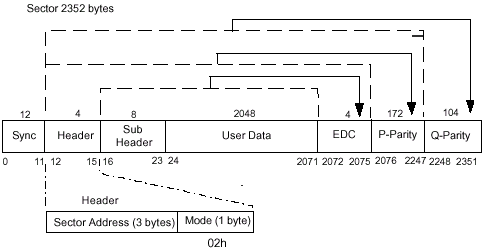
The physical format of DDCD media uses smaller unit of synchronization than the other magnetic or optical recording systems. The basic unit of the data stream synchronization is a small frame. This is different from large frame (sector) as referred to in the HMSF unit. Each small frame consists of 588 bits. A sector on DDCD media consists of 98 small frames.

A DDCD small frame consists of:

1. 1 synchronization pattern (24+3 bits)
2. 1 byte of sub-channel data (14+3 bits)
3. 24 bytes of data (24 x (14+3) bits)
4. 8 bytes of CIRC code (8 x (14+3) bits) Total:588 bits.

Data, sub-channel and CIRC bytes are encoded to 14-bit codes according to the EFM table; then three merging bits are added. The merging bits are chosen to minimize DSV (Digital Sum Value) and provide DC free characteristics. The data bytes of 98 small frames comprise the physical unit of data referred to as a sector. 98 small frames times 24 bytes per small frame equals 2,352 bytes of data per sector.

Sub-Channel Information Formats

The sub-channel 1 byte of each frame is assigned one bit for each of the 8 sub-channels, designated P, Q, R, S, T, U, V, W. Sub-channel P and R to W are all reserved and set to zero. All the sub-channel Q bits of a sector define the sub-channel Q information block. The sub-channel Q block consists of 98 bits, one bit from each small frame in a sector.

The format provides the information of the location and is defined as follows:

1. 2-bits sub-channel synchronization field
2. 4-bits ADR field (defines the format)
3. 4-bits control field (defines the type of information in this sector)
4. 8-bits Track number
5. 8-bits index number
6. 28-bits reserved
7. 28-bits Absolute HMSF address ( 4-bits Hour, 8-bits Minutes, 8-bits Seconds, 8-bits Frames)
8. 16-bits CRC error detection code

TNO = 01 to 99 is the track number in BCD
INDEX = 00.
AHOUR, AMIN, ASEC, AFRAME
= the absolute time address expressed in 7 BCD digits.

 

Review Pages

1. Basic Specifications
2. FAQ
3. How did they done it?
4. Media
5. Recording
6. Disc Structure
7. Sector Structure
8. Recordable Structure
9. Packet Layout


Pages

  • « first
  • ‹ previous
  • 1
  • 2
  • 3
  • 4
  • 5
  • 6
  • 7
  • 8
  • 9
  • next ›
  • last »

Tags:
Previous Post
32x CD-RW Roundup Vol3
Next Post
Roxio Ez CD Creator 5.0 CD-R Software

Related Posts

Latest Reviews

Swit NP-FZ100 Battery
Cameras

Swit NP-FZ100 Battery

The Technology Stack Behind Modern Digital Gaming Platforms
Consumer Electronics

The Technology Stack Behind Modern Digital Gaming Platforms

be quiet! Dark Rock Pro 6
Cooling Systems

be quiet! Dark Rock Pro 6

How Online Casinos Use Encryption, Verification, and Risk Controls to Build User Trust
Enterprise & IT

How Online Casinos Use Encryption, Verification, and Risk Controls to Build User Trust

Why Low-Latency Infrastructure Matters More Than Raw Specs
Enterprise & IT

Why Low-Latency Infrastructure Matters More Than Raw Specs

Popular News

TEAMGROUP Launches EXPERT P34F Find My External SSD

TEAMGROUP Launches EXPERT P34F Find My External SSD

CORSAIR announces Vanguard Pro 96 and Vanguard 96 Gaming Keyboards

CORSAIR announces Vanguard Pro 96 and Vanguard 96 Gaming Keyboards

Samsung announces Galaxy Tab S11 and Galaxy S25 FE series

Samsung announces Galaxy Tab S11 and Galaxy S25 FE series

MSI Launches FORGE GK600 TKL WIRELESS Special Edition Compact Mechanical Keyboard

MSI Launches FORGE GK600 TKL WIRELESS Special Edition Compact Mechanical Keyboard

Viltrox Showcases Upcoming Lens Lineup and New TTL Flash at IBC 2025

Viltrox Showcases Upcoming Lens Lineup and New TTL Flash at IBC 2025

Panasonic Introduces the First Ultra-Telephoto Zoom Lens in the LUMIX S Series

Panasonic Introduces the First Ultra-Telephoto Zoom Lens in the LUMIX S Series

MSI Launches DATAMAG 40Gbps Magnetic Portable SSD

MSI Launches DATAMAG 40Gbps Magnetic Portable SSD

Viltrox Joins the L-Mount Alliance, Expanding Creative Possibilities

Viltrox Joins the L-Mount Alliance, Expanding Creative Possibilities

Main menu

  • Home
  • News
  • Reviews
  • Essays
  • Forum
  • Legacy
  • About
    • Submit News

    • Contact Us
    • Privacy

    • Promotion
    • Advertise

    • RSS Feed
    • Site Map
  • About
  • Privacy
  • Contact Us
  • Promotional Opportunities @ CdrInfo.com
  • Advertise on out site
  • Submit your News to our site
  • RSS Feed