

Intel's Silicon Photonics Advancement to Accelerate Future Computing, Communications
Researchers from Intel have de
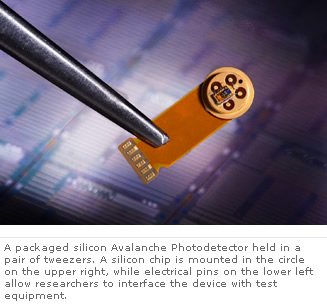
The researchers used a silicon-based Avalanche Photodetector (APD) that could lower costs and improve performance as compared to commercially available optical devices, according to Intel. The research results were published today in Nature Photonics.
The avalanche photodetector (APD) shows the way to designs that could increase the distance or lower power and cost of optical links, Intel said.
Silicon Photonics is an emerging technology using standard silicon to send and receive optical information among computers and other electronic devices. The technology aims to address future bandwidth needs of data-intensive computing applications such as remote medicine and lifelike 3-D virtual worlds.
 Ultra-fast transfer of data will be essential for future computers powered by many processor cores. Silicon Photonics-based technology could deliver higher-speed mainstream computing at a lower cost. This advance builds upon previous Intel breakthroughs such as fast silicon modulators and hybrid silicon lasers. Combined, these technologies could lead to the creation of entirely new kinds of digital machines capable of far greater performance than today.
A team led by Intel researchers created the silicon-based APD, a light sensor that achieves superior sensitivity by detecting light and amplifying weak signals as light is directed onto silicon. This APD device used silicon and CMOS processing to achieve a "gain-bandwidth product" of 340 GHz -- the best result ever measured for this key APD performance metric. This opens the door to lower the cost of optical links running at data rates of 40Gbps or higher and proves, for the first time, that a silicon photonics device can exceed the performance of a device made with traditional, more expensive optical materials such as indium phosphide.
"This research result is another example of how silicon can be used to create very high-performing optical devices," said Mario Paniccia, Ph.D., Intel Fellow and director of the company's Photonics Technology Lab. "In addition to optical communication, these silicon-based APDs could also be applied to other areas such as sensing, imaging, quantum cryptography or biological applications."
Intel worked with industry and academic collaborators, and the research was jointly funded by Defense Advanced Research Projects Agency (DARPA). Numonyx, a leading maker of NOR, NAND, RAM and phase change non-volatile memory technologies, provided manufacturing and process expertise. "This achievement is a good example of the effective relationship between Intel and Numonyx," said Yonathan Wand, Numonyx manufacturing vice president and Fab1 plant manager. "We are committed to enhancing this relationship, to enable further breakthroughs in the Silicon Photonics area."
Prof. Joe Campbell of the University of Virginia and Prof. John Bowers of the University of California, Santa Barbara, both APD experts, provided consultation and assisted with testing.
"This APD utilizes the inherently superior characteristics of silicon for high-speed amplification to create world-class optical technology," Bowers said. "We were glad to help characterize these devices and will continue to work with Intel to realize the full potential of silicon photonics devices."
The avalanche photodetector (APD) shows the way to designs that could increase the distance or lower power and cost of optical links, Intel said.
Silicon Photonics is an emerging technology using standard silicon to send and receive optical information among computers and other electronic devices. The technology aims to address future bandwidth needs of data-intensive computing applications such as remote medicine and lifelike 3-D virtual worlds.
Ultra-fast transfer of data will be essential for future computers powered by many processor cores. Silicon Photonics-based technology could deliver higher-speed mainstream computing at a lower cost. This advance builds upon previous Intel breakthroughs such as fast silicon modulators and hybrid silicon lasers. Combined, these technologies could lead to the creation of entirely new kinds of digital machines capable of far greater performance than today.
A team led by Intel researchers created the silicon-based APD, a light sensor that achieves superior sensitivity by detecting light and amplifying weak signals as light is directed onto silicon. This APD device used silicon and CMOS processing to achieve a "gain-bandwidth product" of 340 GHz -- the best result ever measured for this key APD performance metric. This opens the door to lower the cost of optical links running at data rates of 40Gbps or higher and proves, for the first time, that a silicon photonics device can exceed the performance of a device made with traditional, more expensive optical materials such as indium phosphide.
"This research result is another example of how silicon can be used to create very high-performing optical devices," said Mario Paniccia, Ph.D., Intel Fellow and director of the company's Photonics Technology Lab. "In addition to optical communication, these silicon-based APDs could also be applied to other areas such as sensing, imaging, quantum cryptography or biological applications."
Intel worked with industry and academic collaborators, and the research was jointly funded by Defense Advanced Research Projects Agency (DARPA). Numonyx, a leading maker of NOR, NAND, RAM and phase change non-volatile memory technologies, provided manufacturing and process expertise. "This achievement is a good example of the effective relationship between Intel and Numonyx," said Yonathan Wand, Numonyx manufacturing vice president and Fab1 plant manager. "We are committed to enhancing this relationship, to enable further breakthroughs in the Silicon Photonics area."
Prof. Joe Campbell of the University of Virginia and Prof. John Bowers of the University of California, Santa Barbara, both APD experts, provided consultation and assisted with testing.
"This APD utilizes the inherently superior characteristics of silicon for high-speed amplification to create world-class optical technology," Bowers said. "We were glad to help characterize these devices and will continue to work with Intel to realize the full potential of silicon photonics devices."