Brain power: Your Wish is the Computer's Command
The sci-fi dream of using brain power to move or speak is now within
reach, according to two studies on brain-computer interface technology due out Thursday in the science journal Nature.
Advances in neuromotor prosthetics, the researchers say, could offer a revolutionary way
for people with brain or spinal injuries to move, communicate and manipulate objects.
In the first study, led by Leigh Hochberg of the Massachussetts General Hospital (MGH) and John Donoghue of Brown University, a 25-year-old man paralyzed after a spinal cord injury three years ago was able to open email, operate a television and open and close a prosthetic hand -- all by imagining movement.
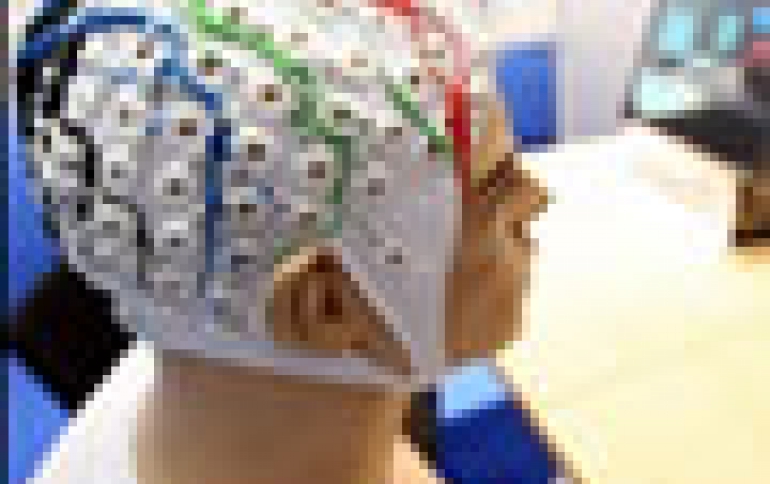
The test subject was wired with 96 electrode sensors in the motor cortex part of his brain. Each thought generated millions of neuronal signals which were picked up by the sensors, decoded and processed by a computer, and finally translated into movement commands.
"We're finding that, even years after spinal cord injury, the same signals that originally controlled a limb are available and can be utilized," Hochberg said in a statement released by the MGH.
The technology, called BrainGate Neural Interface System, is not the first time a neuromotor prosthetic has been implanted in a brain, researcher Stephen Scott said in a Nature commentary, but its creators are reporting the most advanced results so far.
In a second study on two monkeys, Krishna Shenoy and Gopal Santhanam of Stanford University found that they could speed up data transmission using neuro-motor prosthetics so that paralyzed people could communicate at a speed of up to 15 words per minute.
The considerable advances do not, however, mean the brain-computer technology is ready for widespread use. Scott warned there were "considerable problems" left to settle, notably finding a way to go wireless to reduce risk of infection.
In the first study, led by Leigh Hochberg of the Massachussetts General Hospital (MGH) and John Donoghue of Brown University, a 25-year-old man paralyzed after a spinal cord injury three years ago was able to open email, operate a television and open and close a prosthetic hand -- all by imagining movement.
The test subject was wired with 96 electrode sensors in the motor cortex part of his brain. Each thought generated millions of neuronal signals which were picked up by the sensors, decoded and processed by a computer, and finally translated into movement commands.
"We're finding that, even years after spinal cord injury, the same signals that originally controlled a limb are available and can be utilized," Hochberg said in a statement released by the MGH.
The technology, called BrainGate Neural Interface System, is not the first time a neuromotor prosthetic has been implanted in a brain, researcher Stephen Scott said in a Nature commentary, but its creators are reporting the most advanced results so far.
In a second study on two monkeys, Krishna Shenoy and Gopal Santhanam of Stanford University found that they could speed up data transmission using neuro-motor prosthetics so that paralyzed people could communicate at a speed of up to 15 words per minute.
The considerable advances do not, however, mean the brain-computer technology is ready for widespread use. Scott warned there were "considerable problems" left to settle, notably finding a way to go wireless to reduce risk of infection.