
Gainward GTX260 1792MB
1. Features, specifications
Review Pages
The Nvidia GTX260 series has been quite succesful for Nvidia and its partners. Gainward has released a special version of the GTX260 platform that comes with double GDDR3 memory on board, reaching the magic number of 1792MB.

The Gainward GTX260 1792MB GDDR3 is actually based at the GTX260 Core 216 series that compared with the previous GTX260 GPU but it comes with increased number stream processors. People tend to agree that performance gain should be around 5~10%, which wouldn't be enough for most users to upgrade. It would be interesting to compare an overclocked version of the first GTX260 with the new Gainward GTX260 Core 216. Below is a table showing the main differences among the Nvidia GTX 2xx graphic series chipsets and their respective average prices :
| GTX 295 | GTX 285 | GTX 280 | GTX 260 Core 216 | GTX 260 | |
| Stream Processors | 2 x 240 | 240 | 240 | 216 | 192 |
| Texture Address / Filtering | 2 x 80 / 80 | 80 / 80 | 80 / 80 | 72/72 | 64 / 64 |
| ROPs | 28 | 32 | 32 | 28 | 28 |
| Core Clock | 576MHz | 648MHz | 602MHz | 576MHz | 576MHz |
| Shader Clock | 1242MHz | 1476MHz | 1296MHz | 1242MHz | 1242MHz |
| Memory Clock | 999MHz | 1242MHz | 1107MHz | 999MHz | 999MHz |
| Memory Bus Width | 2 x 448-bit | 512-bit | 512-bit | 448-bit | 448-bit |
| Frame Buffer | 2 x 896MB | 1GB | 1GB | 896MB | 896MB |
| Transistor Count | 2 x 1.4B | 1.4B | 1.4B | 1.4B | 1.4B |
| Manufacturing Process | TSMC 55nm | TSMC 55nm | TSMC 65nm | TSMC 65nm | TSMC 65nm |
| Price range | $500 | $400 | $350 - $400 | $250 - $300 | $250 - $300 |
Compared to typical Nvidia GTX260, the Gainward GTX260 Core 216 is slightly overclocked with 585MHz (+9MHz) for the Core, 1262MHZ (+20MHz) for the Shader and 999MHz (+0MHz) for the memory. But as we previously mentioned, the Gainward model is equipped with 1792MB of GDDR3 (double the normal memory).
- Retail package
Gainward used its typical blue-colored packaging for the new GTX260 216 1792MB graphics card. Its price is around &euro215 (including VAT), which is €20-25 more compared to the price of an overclocked GTX260 solution.

The graphics card is well packaged into a plastic anti static bag and a carton box. Don't expect to find any retail game inside. What we found was just a printed manual, a driver's disc, a molex-to-pci-e adapter, a DVI-to-HDMI adapter, a DSub-to-DVI-D adapter, a TV-out cable with HDTV support and finally an Internal SPDIF cable, for HDMI audio support.


The Gainward GTX260 216 is equipped with a special cooling system with dual 80mm fans. The design offers effective cooling as well as low noise, but makes the graphics card thicker occupying two slots in your PC after installation.

The available outputs are two DVI-D and one for HDTV.
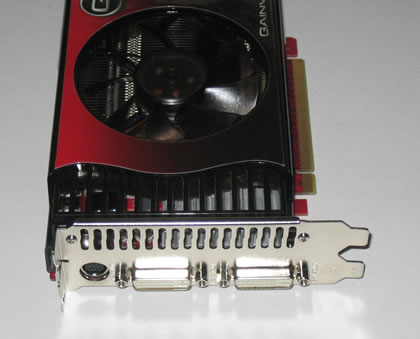
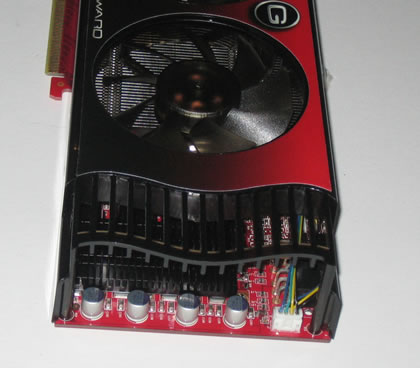
The Gainward GTX260 216 requires at least two 6-pin power jacks in order to work properly. Make sure that you have a 600Watt PSU at least before buying this graphics card.

Nvidia's SLI is possible with all currently sold GTX 2xx series. Just make sure that both cards are identical.

For our tests, we used the latest Nvidia drivers (185.81) in order to get the highest possible performance, especially with the latest DX10 game titles.
According to GPU-Z, the GPU core runs at 585MHz and the memory at 1262MHz:


The NvidiaBios Editor v5.0 provides more information about the voltages of the card.. The software also allows you to "tweak" the graphics card and get an even higher performance.

