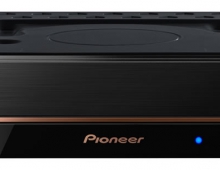
Pioneer BDR-101A Blu-Ray Drive Preview
1. The Drive
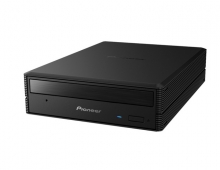
 The following pages are a brief preview, which will give you an idea of how the first and highly
anticipated Blu-Ray drive from Pioneer performs in basic writing and reading
tasks. The Pioneer BDR-101A supports the reading and writing of both
write-once (BD-R) and rewritable (BD-RE) single-layer Blu-ray discs at the 2X
speed,
which translates to a data transfer rate of 72Mbps. Single-layer Blu-ray discs provide up to 25GB storage capacity
on a single-sided disc.
The following pages are a brief preview, which will give you an idea of how the first and highly
anticipated Blu-Ray drive from Pioneer performs in basic writing and reading
tasks. The Pioneer BDR-101A supports the reading and writing of both
write-once (BD-R) and rewritable (BD-RE) single-layer Blu-ray discs at the 2X
speed,
which translates to a data transfer rate of 72Mbps. Single-layer Blu-ray discs provide up to 25GB storage capacity
on a single-sided disc.
The BDR-101A was designed for professional users, providing authoring facilities to perform pre-mastering of commercial BD releases in preparation for replication. However, it is also suited for advanced storage - typically demanded by high definition broadcast and video content.
The drive promises the optimum combination of performance and storage capacity. For example, to record a film of 135 minutes at a high definition (HD) bit-rate of 19.4Mbps, you’d typically require 19.6GB of storage space – equivalent to around 4 single-layer DVDs – whereas a single Blu-ray disc can easily accommodate the movie and a range of interactive extras.
- Features

Highlight features of the BDR-101A include reading and writing on DVD
and BD, using a pickup equipped with the newly developed BD/DVD compatible
lens, which realises high-speed recording at a maximum speed of 2X on
BD-R/RE
2X speed media. The drive will read BD-ROM and DVD-ROM discs, and read or write
on DVD-R/+R, DVD-RW/+RW and Dual/Double-Layer DVD-R/+R discs.
- Specifications
| Write Support | |
| BD | BD-R, BD-RE (single layer) |
| DVD | DVD-R/DVD+R (4.7Gbytes single layer), DVD-R/DVD+R (dual/double layer), DVD-RW/DVD+RW |
| Read Support | |
| BD | BD-ROM, BD-R, BD-RE |
| DVD | DVD-ROM, DVD-R/DVD+R (single & double layer), DVD-RW, DVD+RW |
| Write Speed | |
| BD-R | 2x, 1x |
| BD-RE | 2x, 1x |
| DVD+/-R | 8x, 6x, 4x, 2x, 1x |
| DVD - RW | 4x, 2x, 1x |
| DVD + RW | 4x, 3.3x, 2.4x |
| DVD + R (Double Layer) | 2.4x |
| DVD - R (Double Layer) | 2x |
| Read Speed | |
| BD-R | Max 2x CAV |
| BD-RE | Max 2x CAV |
| BD-ROM | Max 2x CAV |
| DVD-ROM (Single) | Max 8x CAV |
| DVD-ROM (Dual) | Max 6x CAV |
| DVD-R, DVD-RW | Max 6x CAV |
| DVD+R, DVD+RW | Max 6x CAV |
| Interface | |
| ATAPI Interface | ATAPI device (ATA-5 & SFF-8090 Ver 5) |
| IDE Data Transfer Mode | PIO Mode 4, Multi Word DMA Mode 2, Ultra DMA Mode 2, and Ultra DMA Mode 4 (Ultra DMA 66) |
| Audio Interface | Analog Audio Output |
| Other Specifications | |
| Data Buffer | BD (8 Mb), DVD (2Mb) |
| Mounting Orientation | Horizontal and Vertical |
| Dimensions | |
| Dimensions (mm) | 148mm x 42.3mm x 198mm |
| Weight | 1.1 kg, 2.42 lbs |
The Pioneer BDR-101A uses an 8MB buffer for BD and a 2MB buffer for DVD content.
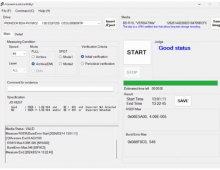
Below are the main specs as given by NeroInfoTool and DVDInfoPro:

The drive is compliant with the AACS interim specifications.


- The Drive
The BDR-101A comes bundled with a copy of Roxio DigitalMedia LE v7 software, which provides professional facilities for performing testing and evaluation of commercial BD releases in preparation for replication. Roxio components will also enable image to disc recording, saving of BD disc images and data transfer for file backup on Blu-ray media.


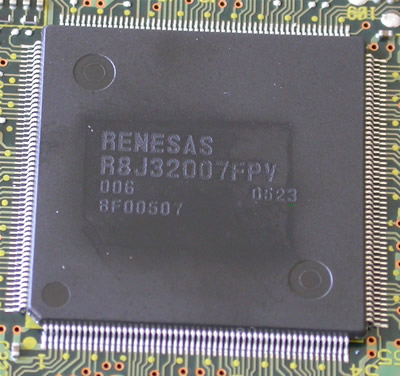
We do not recommend removing the drive's cover, since this will void the manufacturer's warranty, especially when the drive costs around $1000. You can take a look inside the drive with the pictures below. Click on the image below for a larger and more detailed photograph.

The drive is powered by the Pioneer PD5912A chipset.


- Installation
The device was connected to our test PC and was identified as "PIONEER BD-RW BDR-101A" under Win XP. The drive came with firmware version 1.01 installed, which at the time of this preview was the latest available.