PowerColor X300
1. Introduction
01 - Introduction
 With
Doom 3 on store shelves and the upcoming release of Half life 2 driving people
insane, more and more people everyday re-evaluate their need for
a VGA upgrade. All
the different brands, codenames and product families, PCI-Express or
AGP, only add to the confusion for someone trying to make a decision.
Over time and with forthcoming reviews, we will try to pinpoint and clarify
all these differences between the models and
explain
the
technologies available on the market.
With
Doom 3 on store shelves and the upcoming release of Half life 2 driving people
insane, more and more people everyday re-evaluate their need for
a VGA upgrade. All
the different brands, codenames and product families, PCI-Express or
AGP, only add to the confusion for someone trying to make a decision.
Over time and with forthcoming reviews, we will try to pinpoint and clarify
all these differences between the models and
explain
the
technologies available on the market.
In this review, we will be investigating Powercolor's X300. The X300 is ATi's latest chipset which is designed expressly (no pun intended) for the PCI-Express architecture.
But what is PCI-Express anyway?
PCI-Express is an I/O interconnect bus standard that expands on and doubles the data transfer rates of original PCI. PCI Express is a two-way, serial connection that carries data in packets along two pairs of point-to-point data lanes, compared to the single parallel data bus of traditional PCI that routes data at a set rate. Initial bit rates for PCI Express reach 2.5Gb/s per lane direction, which equate to data transfer rates of approximately 200MB/s. PCI Express was developed so that high-speed interconnects such as 1394b, USB 2.0, InfiniBand and Gigabit Ethernet would have an I/O architecture suitable for their transfer high speeds. (Extract taken from Webopedia.com).
 In
simple terms, you'll need it if you want to install your graphics
card on your motherboard. Currently, unless your computer is more than
6 years old, your VGA card is seated in the AGP slot on your motherboard.
As today's and tomorrow's processors and Input/Output (I/O) devices demand
much higher bandwidth than AGP 8X can provide, PCI-Express was created just
for such a need with a maximum bandwidth of 16X. In the following 2 years,
AGP will be phased out
as all
VGA cards, soundcards and other peripherals will be manufactured for PCI-Express
capable motherboards. However, for the time being, PCI-Express is backwards
compatible, meaning that it still uses the same principles as PCI2.2 to
avoid application and driver problems. Due to these compatibility restriction,
an issue in performance arises since the AGP8X version of a VGA card
is currently faster than the newer PCI-E version.
In
simple terms, you'll need it if you want to install your graphics
card on your motherboard. Currently, unless your computer is more than
6 years old, your VGA card is seated in the AGP slot on your motherboard.
As today's and tomorrow's processors and Input/Output (I/O) devices demand
much higher bandwidth than AGP 8X can provide, PCI-Express was created just
for such a need with a maximum bandwidth of 16X. In the following 2 years,
AGP will be phased out
as all
VGA cards, soundcards and other peripherals will be manufactured for PCI-Express
capable motherboards. However, for the time being, PCI-Express is backwards
compatible, meaning that it still uses the same principles as PCI2.2 to
avoid application and driver problems. Due to these compatibility restriction,
an issue in performance arises since the AGP8X version of a VGA card
is currently faster than the newer PCI-E version.
Even though the X300 is aimed at the budget minded, ATi raised the standard for low-end cards and built it using a 0.11 micron process giving the card some really strong points as you will see for yourself later on.
- Packaging - Bundle
The card ships in a relatively small package. Nothing fancy here, just a plain black box wrapped in Powercolor's metallic theme. On the front you can clearly see the card's main features, 256MB memory and 128 bit bus along with support for DirectX 9 and OpenGL.
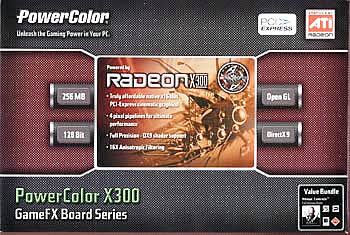
Inside the package you'll find as usual a DVI-I Connector, S-Video cable,
composite video cable and a printed version of the manual.


Bundled along inside a "ProPack" cardboard cd-case is a full version of Hitman: Contracts, a Cyberlink DVD Solution Suite (featuring Powerdirector, Mediashow, PowerDVD, PowerProducer DVD and Power2Go) and of course a CD with ATi's drivers and some additional utilities