Philips DVDRW885K DL
1. Installation - Retail Package
Review Pages
2. Data CD Reading Tests
3. Error Correction Tests
4. DVD reading tests
5. DVD Error Correction Tests
6. Protected Disc Tests
7. DAE Tests
8. CD Recording Tests
9. Writing Quality Tests - 3T Jitter Tests
10. C1 / C2 Error Measurements
11. DVD Recording Tests
12. KProbe PI/PIF quality results
13. KProbe PI/PIF quality results for DL
14. Booktype Feature
15. 885K vs. SA300 - Page 1
16. 885K vs. SA300 - Page 2
17. 885K vs. SA300 - Page 3
18. 885K vs. SA300 - Page 4
19. DL Compatibility Tests
20. Conclusion
Philips DVDRW885K Double Layer - Page 1
 Philips
was the first manufacturer to develop DL recording, in cooperation with
Mitsubishi Chemicals. The brand new recorder from Philips supporting this
feature is the DVDRW885K. The recording speed for this
format is up to 2.4X. The drive also supports DVD+R/RW recording with speeds
at 8X and 4X respectively. In the CD category, the drive offers 24X for
CD-R and 16X for CD-RW media.
Philips
was the first manufacturer to develop DL recording, in cooperation with
Mitsubishi Chemicals. The brand new recorder from Philips supporting this
feature is the DVDRW885K. The recording speed for this
format is up to 2.4X. The drive also supports DVD+R/RW recording with speeds
at 8X and 4X respectively. In the CD category, the drive offers 24X for
CD-R and 16X for CD-RW media.
Below are summarized the drive's features according to Philips:
- 8.5 GB storage capacity
Single sided double layer disc with 8.5 GB storage capacity. - Single sided, double layer
Two layers accessible from the same side of the disc, so no need to turn the disc. - Dynamic Calibration
Dynamic Calibration optimizes DVD writing quality of high-speed DVD+RW drives. - DVD compatibility
DVD Compatibility ensures playability of self-made DVD discs on as many set-top players and DVDROMs as possible. - Seamless Link
Seamless Link prevents loss of discs caused by writing errors. - Thermo Balanced Writing
Always the best and fastest recording of any of your recordable discs. - Smart disc detection
Application software feature detecting the actual disc used and automatically selecting the correct applications. - Extensive Software Package
Complete software bundle offering all functionality in a simple intuitive way. - How to.. manual
Photo guided step by step tour through both installation process and applications. - Intuitive Software Launcher
Intuitive launch screen to provide an overview of all available applications and to start them.
 Seamless
Link was initially introduced by Acer CM (now BenQ). This technology
allows a CD-RW/DVD+RW drive to automatically monitor the recording status to
prevent
buffer under run from occurring.
Seamless
Link was initially introduced by Acer CM (now BenQ). This technology
allows a CD-RW/DVD+RW drive to automatically monitor the recording status to
prevent
buffer under run from occurring.
Seamless Link allows the CD-RW drive to store the RecEnd address, the point in the data to which the recording mechanism has progressed, and pause the recording before a buffer under run occurs. When the buffer is again full, a Seamless Link-enabled drive locates the RecEnd address and resumes the recording process. The gap between the stop and restart point is closed, while managing the recording process precisely and transparently-eliminating under run errors while maintaining recording accuracy.
Dynamic Calibration
To ensure optimal writing quality over the entire disc at higher writing speeds, Philips has introduced the Walking OPC algorithm. WOPC directly measures and optimizes the actual writing quality during the writing process.
At certain intervals, the writing process will be briefly interrupted, the writing quality directly evaluated and the writing power adjusted accordingly, if required. The Philips DVD+R/RW writers use a more dynamic implementation based on position on the disc and temperature inside the drive. The graph below shows the writing graph of the Philips 8x DVD+R/RW on a Philips 8x DVD+R disc.

In addition, Philips Dynamic Calibration includes a tilt calibration feature. The best reading and writing quality can be obtained if the angle between the disc and the laser beam is 90 degrees. However, if the disc is warped, the laser beam will no longer be correctly positioned which will cause a distortion of the laser spot which will result in decreased writing quality if it is not corrected.
The tilt calibration will reposition the Optical Pickup Unit (OPU) to maintain a 90-degree angle between the laser beam and the disc surface at all times ensuring an optimal spot shape, even on warped discs. The frequency of the tilt calibration depends only on the position on the disc according to a non-linear function. Near the end of the disc the risk for warping is higher so the frequency of the tilt calibration will increase accordingly. As with WOPC, the writing process will be briefly interrupted, the tilt measured and the OPU repositioned if required.
Walking OPC and Tilt Calibration together form the Dynamic Calibration. Although they act independently from each other, some effort is taken to synchronize the Tilt Calibrations with the disc position dependent component of Walking OPC.
- Specifications
|
||||||||||||||||||||||||||||||
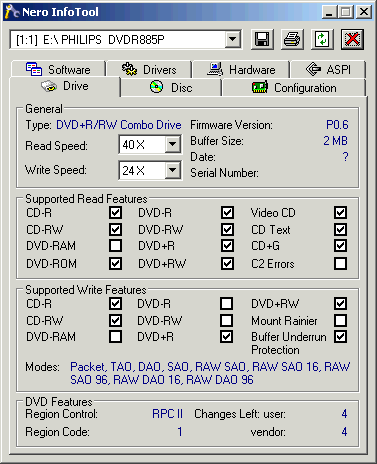
More information about the drive in the following screenshots from Nero Info Tool and DVD Info Pro:


- Retail package
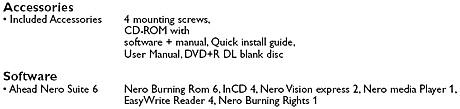
Below is given the retail packages with all the appropriate inclusions. You can see written on the box, the capacity of 8.5GB.

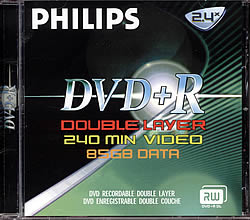
The specific DL media is from Mitsubishi Chemicals.

- The drive
The DL logo on the upper left makes the difference.


Removing the screws and opening the drive's cover voids the drive's warranty. For reference reasons, we post the following pictures.

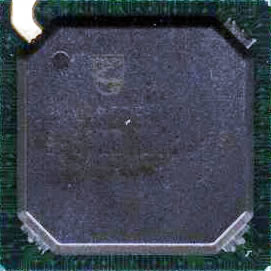
The main chipset comes from the NEXPERIA series.
- Installation
The Philips drive was connected to our test PC and was identified as "PHILIPS DVDR885P" under WinXP. All tests were done with firmware P0.6.

In the following pages we have the results of the Philips DVDRW885K in comparison with the previous Philips model, the DVDRW824P.
Review Pages
2. Data CD Reading Tests
3. Error Correction Tests
4. DVD reading tests
5. DVD Error Correction Tests
6. Protected Disc Tests
7. DAE Tests
8. CD Recording Tests
9. Writing Quality Tests - 3T Jitter Tests
10. C1 / C2 Error Measurements
11. DVD Recording Tests
12. KProbe PI/PIF quality results
13. KProbe PI/PIF quality results for DL
14. Booktype Feature
15. 885K vs. SA300 - Page 1
16. 885K vs. SA300 - Page 2
17. 885K vs. SA300 - Page 3
18. 885K vs. SA300 - Page 4
19. DL Compatibility Tests
20. Conclusion