VGA Roundup
1. Sapphire Radeon 9800 Pro Ultimate
Review Pages
2. Exair Radeon 9800 XT
3. Asus V9950 FX 5900 GE
4. Exair GeForce FX 5900 XT
5. Test specifications
6. 3DMark Benchmark tests
7. Aquamark3 Benchmark tests
8. Codecreatures Benchmark tests
9. GL Excess Benchmark tests
10. Farcry & Painkiller tests
11. Unreal Tournament 2004 & 2003 tests
12. Halo & Tomb Raider:AOD tests
13. Overclocking
14. Conclusion
SAPPHIRE RADEON 9800 PRO ULTIMATE 128MB
 After
the Cebit exhibition we eagerly have been waiting to get the first VGA card.
When Sapphire's 9800 Pro came first to our office, a sense of both amazement
and thrill overshadowed us. We all had in mind that with this card, CDRInfo
was about to make its debut in the VGA card section. And yes, the Radeon 9800
Pro is a good milestone to start our VGA section establishment with.
After
the Cebit exhibition we eagerly have been waiting to get the first VGA card.
When Sapphire's 9800 Pro came first to our office, a sense of both amazement
and thrill overshadowed us. We all had in mind that with this card, CDRInfo
was about to make its debut in the VGA card section. And yes, the Radeon 9800
Pro is a good milestone to start our VGA section establishment with.
Sapphire best known for its qualitative products, offered to send us its 128 MB DDR Radeon 9800 Pro Atlantis. Although a new generation of ATI's VGA cards based on the R420 GP has launched, its previous high-tech answers included the 9800 Pro card which is widely known for its good performance and high overclocking capabilities.
But let's see what the ultimate version has to offer.
- Specifications
| GPU | RADEON 9800 PRO VPU (R350) |
| Memory Bus Width | 128 MB DDR |
| Memory interface | 256 Bit DDR |
| Memory Type | DDR1 |
| Core clock | 380 MHz |
| Memory clock | 680 Mhz (340x2) |
| Memory Bandwidth | 21.8 GB/sec |
| Pixel FillRate | 3.04 Gpixels/sec |
| Geometry rate | 380 Mtriangles/sec |
| Bus | 2x/4x/8x |
| Processing technology | 0.13µ |
| Output Connections | VGA + TV + DVI |
| Cooling | Zalman double-side Heat sink |
| 2D supported Resolutions & Hz | 640x480@200, 800x600@200, 1024x768@200, 1152x864@100, 1280x1024@160, 1600x1200@120, 1920x1080@100, 1920x1200@100, 1920x1440@85, 2048x1536@75 |
| 3D Maximum resolution | 2048x1536 with 16.7M colors |
| Anisotropic Filtering modes | 2x/4x/8x/16x |
| Anti-Aliasing modes | 2x/4x/6x |
| Ramdac | 400 Mhz |
| Pipelines | 8 |
| Texture unit per pixel pipeline | 1 |
| Technologies supported | - SMARTSHADER 2.1 technology allows users to experience complex, movie-quality
effects in next-generation 3D games and applications - SMOOTHVISION 2.1 technology enhances image quality by removing jagged edges and bringing out fine texture detail, without compromising performance - Unique VIDEOSHADER engine uses programmable pixel shaders to accelerate video processing and provide better-looking visuals - FULLSTREAM technology removes blocky artifacts from Streaming and Internet video and provides sharper image quality - HyperZ III+ technology improves rendering performance |
| Pixel Shader Support | 2.0+ |
| Vertex Shader Support | 2.0+ |
| DTV/HDTV Decoding | Supported |
| Package contents | -Instruction Manual -Installation Driver Disk -Cyberlink Power DVD -Redline Tweak Utility -Tomb Raider : The Angel of Darkness -S-Video Cable -RCA Cable -DVI to VGA Adapter -S-Video to RCA Adapter |
| System requirements | The system requirements for the card and complementary
software: |
- 3D Mark Detailed specifications

- The chipset
What's special for the Ultimate series? The non-ultimate series are equipped with a huge fan which covers the core of the chipset. Fans are noisy and as every movie-lover knows, the most irritating thing when watching a movie is the bumbling noise of the cooling fan.
Daniel Forster, Sapphire's Senior Manager
said the following about the Ultimate series: "This card was built to
enable people to be able to build silent yet powerful systems. You want to
hear your movies or games in a PC not all the fans in the system - so in the
future noise levels this will become more and more important with PC moving
into the living room as all round multimedia machines. This is why we build
these cards."
According to Mr Forster, the noise problem was the key factor for the development
of the Ultimate series. As you can see from the following picture, the irritating
fan has been substituted with a double-sided, massive but silent heat pipe
system.

Front side

Back side
The only problem with the fluid-cooling system is its massive size. Unfortunately it takes the place of the PCI slot which is next to the AGP. Although it is little bunglesome, it does its job with absolute silence.

Front side exposed
Removing the screws we were able to see the chipset. As you can see two small heat sinks protect the DDR memories from overheating. Unstucking them we were able to have a closer look on the DDR.

The card wears the common Samsung K4D26323RA-GC2A memory chips with 2.8ns access time at 680 Mhz.

Removing the heat paste conductor we took a pic of the R350 GPU.

This label verifies that the chipset is nothing more or less than the Radeon 9800Pro 128M DDR
- Deeper look in the cooling system
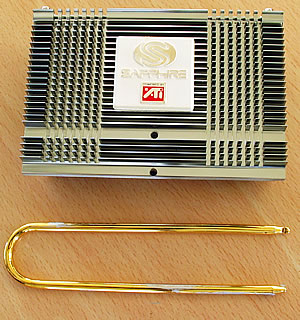
The cooling system is consisted of a massive metallic heatsink which covers the both sides of the card, and a magneto-like pipe.

The thermojunction of the GPU
- How it works

A special liquid is sealed inside the pipe which when it is heated vaporizes. The hot vapor then gets drawn to the other bottom side the heatsink, giving up its heat. After this the vaporized liquid solidifies and it's drawn back to the heat source again. Fascinating, simple and cool!


The Sapphire Atlantis Radeon 9800 Pro Ultimate uses the standard VGA, S-Video, and DVI connections with TV-Out functionality.
- Package contents
 The
package contents the instruction manual and the Installation Driver
Disk for the technical section. The bundle software is consisted
of Cyberlink Power DVD, Redline Tweak Utility and the game
Tomb Raider : The Angel of Darkness. As for the connectivity the card
comes with an S-Video Cable, an RCA Cable, a DVI to VGA
Adapter and an S-Video to RCA Adapter.
The
package contents the instruction manual and the Installation Driver
Disk for the technical section. The bundle software is consisted
of Cyberlink Power DVD, Redline Tweak Utility and the game
Tomb Raider : The Angel of Darkness. As for the connectivity the card
comes with an S-Video Cable, an RCA Cable, a DVI to VGA
Adapter and an S-Video to RCA Adapter.
In the hardware aspect, the Ultimate series chipset is exactly the same as its previous 9800 Pro model. As we have already mentioned the Ultimate model differentiates for its soundless cooling heat pipe system. Also the memory clock speed is lower than the original Pro model (perhaps for overheating reasons).
Review Pages
2. Exair Radeon 9800 XT
3. Asus V9950 FX 5900 GE
4. Exair GeForce FX 5900 XT
5. Test specifications
6. 3DMark Benchmark tests
7. Aquamark3 Benchmark tests
8. Codecreatures Benchmark tests
9. GL Excess Benchmark tests
10. Farcry & Painkiller tests
11. Unreal Tournament 2004 & 2003 tests
12. Halo & Tomb Raider:AOD tests
13. Overclocking
14. Conclusion