Promise FastTrack TX2000
1. Introduction
Promise FastTrack TX2000 - Page 1
ATA133 & RAID in one package
- Introduction
Most advanced users need solutions that will prevent data loss and give the maximum possible performance. The RAID solutions are what most people need, but in past such solutions were possible only with SCSI recorders. Latetly IDE drives can be used also to provide RAID systems for end users. Promise shifts the level by introducing a controlller with not only RAID 0,1 features but also with ATA133 interface connection.
This review has the propose to examine how faster a HD performs under ATA133 interface connection and how does really RAID 0,1, 0+1 performs for end user.
- Features
The Promise FastTrack TX2000 main propose is to offer a cheap RAID 0,1,0+1 option for end users. As Promise posted in the press release of 11th Feb 2002, the TX2000 has the following features:
- FastTrak TX2000 uses two (or more) Ultra ATA/133 drives to perform the work of a single drive -- producing sustained data transfers up to 200% faster than using a single drive Ultra ATA/133 drive. Built-in support for 66MHz PCI bus motherboards allows burst data transfers up to 266MB/sec over the PCI bus.
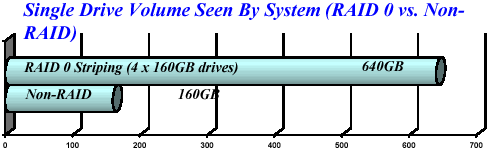
- FastTrak TX2000's BIOS accepts drive sizes larger than 137GB and links (or stripes) up to 4 drives together as a huge single "virtual" drive under RAID 0 when seen by the system. A Windows 2000 system can create a single RAID 0 array of 640GB (i.e. 4 x 160GB drives) or more! This is particularly ideal for professional workstations that produce and read from large files.
- Under RAID 1 or 0+1, FastTrak TX2000 protects against data loss by creating two identical drives (RAID 1) or two pairs of identical striped drives (RAID 0+1). If one drive fails, the remaining working drive(s) maintain user data without loss.
- With ATA RAID 1 or RAID 0+1 arrays, a user's system continues to function if a drive fails because the data has been mirrored to the working drive or pair of drives. In addition, Promise supports hot swap of the failed drive with a replacement drive when used with optional Promise SuperSwap™ 1000 chassises for Ultra ATA/133 drives 2 -- allowing continuous 24 x 7 operation for servers and component protection during replacement.
Why I should select Promise's TX2000 solution and not Win2k/XP included RAID feature?
While Microsoft Windows 2000 and XP does offer basic software-based RAID 0, 1, and 0+1, there are limitations:
- Promise RAID allows booting from all RAID levels. Microsoft RAID does NOT
boot RAID 0 or 0+1 arrays.
- Promise RAID supports most major operating systems. Microsoft RAID is dedicated
to Windows 2000 or XP.
- Promise RAID 1 boots no matter which drive fails. In Windows 2000, Microsoft
RAID 1 requires user to re-configure array manually if primary drive fails in
order to re-boot from remaining drive.
- Promise RAID 1 supports hot swap of failed drive 3 . Microsoft RAID 1 does
NOT support hot swap.
- Promise RAID allows remote monitoring of array(s) via TCP/IP. Microsoft RAID
does NOT.
- Specifications
|
Drive Support
|
Supports Ultra ATA/133 drives; backward
compatible with older Ultra ATA and
EIDE drives |
|
Controller Data Channels
|
Two independent channels assure maximum
performance of each attached drive
|
|
Large LBA Mode
|
48-bit LBA supports drive sizes greater
than 137GB each
|
|
Data Transfer Rate
|
Up to 266MB/sec (depends on drive speed
and use of multiple drives and presence of 66MHz PCI bus)
|
|
RAID Levels
|
RAID 0 striping of up to 4 drives for performance RAID 1 mirroring of 2 drives for fault tolerance RAID 0+1 striping/mirroring of 4 drives JBOD spanning of up to 4 drives for capacity |
|
Data Protection
|
Mirrors data to second drive or drive pair on-the-fly; offers hot spare feature for instant rebuild of failed drive for RAID 1 array; hot swap failed drive and rebuild data in background for continuous PC operation |
|
PCI Bus Support
|
Compatible with 66MHz PCI motherboards;
automatically backward compatible
with 33MHz; PCI 2.2 compliant |
|
Disk Array Support
|
Supports up to 4 arrays with different
RAID levels; different arrays are selectable and bootable
|
|
FastBuild BIOS Auto-Menu
|
Provides auto configuration and optimization;
view/create/delete arrays; rebuilds failed disks
|
|
Promise Array Management Software
|
Windows-based utility monitors status
of arrays, hard drives, and optional Promise SuperSwap 1000 enclosures
via TCP/IP; warns of drive failure; allows rebuilds of mirrored arrays;
synchronization of hard drives
|
|
Advanced Monitoring
|
Monitors S.M.A.R.T. status of attached
hard drives; logs array errors and events to Windows NT/2000/XP Event
Log; supports SNMP (Microsoft and Linux Agent X); supports Linux console
output and management via Linux command line; Linux Syslog compatible;
permits e-mail notification of errors and array events
|
|
Operating Systems Compatibility
|
Windows XP/2000/NT4/Me/9x; RedHat Linux
7.0/7.1/7.2; TurboLinux Workstation 7; SuSE Linux 7.2; Caldera OpenLinux
3.1
|