SATA vs SATA II
1. Introduction
 In 2002, Serial ATA (SATA) was introduced as the next step in ATA technology. SATA provides greater scalability, simpler installation, thinner cabling and faster performance (up to 3.0 GB/s). SATA also maintains backward compatibility with Parallel ATA drivers.The entire desktop market has started moving towards the SATA interface from the more traditional Parallel ATA interface.
The term SATA II has grown in popularity as the moniker for the SATA 3Gb/s data transfer rate, causing great confusion with customers because, quite simply, it’s a misnomer.
The first step toward a better understanding of SATA is to know that SATA II is not the brand name for SATA’s 3Gb/s data transfer rate, but the name of the organization formed to author the SATA specifications. The group has since changed names, to the Serial ATA International Organization, or SATA-IO.
The 3Gb/s capability is just one of many defined by the former SATA II committee, but because it is among the most prominent features, 3Gb/s has become synonymous with SATA II. Hence, the source of the confusion.
The foregoing is taken from the sata-io.org web site (Naming Guidelines).
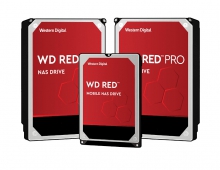
In this review, we are going to compare the performance of a SATA II HDD with a SATA 1.0 HDD. For our tests, we used two Western Digital Hard Discs, the WD2500JS (SATA II) and the WD3000JD (SATA).

 |
| the two Western Digital HDDs we used... |
- Specifications
| Performance Specifications | ||
| Model | WD2500JS (SATA II) | WD3000JD (SATA) |
| Rotational Speed | 7,200 RPM (nominal) | |
| Buffer Size | 8 MB | |
| Average Latency | 4.20 ms (nominal) | |
| Seek Times | ||
| Read Seek Time | 8.9 ms | |
| Track-To-Track Seek Time | 2.0 ms (average) | |
| Full Stroke Seek | 21.0 ms (average) | |
| Transfer Rates | ||
| Buffer To Host (Serial ATA) | 300 MB/s (Max) | 150 MB/s (Max) |
| Buffer To Disk | 748 Mbits/s (Max) | |
| Physical Specifications | ||
| Formatted Capacity | 250,059 MB | 300,069 MB |
| Capacity | 250 GB | 300 GB |
| Interface | SATA 300 MB/s | SATA 150 MB/s |
| Bytes Per Sector | 512 | |
| User Sectors Per Drive | 488,397,168 | 586,072,368 |
| Servo Type | Embedded | |
| Physical Dimensions | ||
| Height | 26.1 mm (Max) | |
| Length | 147 mm (Max) | |
| Width | 101.6 mm | |
| Weight | 0.6 kg (+/- .082 kg) | 0.73 kg (+/- .082 kg) |
| Environmental Specifications | ||
| Shock | ||
| Operating Shock (Read) | 65G, 2 ms | |
| Non-operating Shock | 350G, 2 ms | 250G, 2 ms |
| Acoustics | ||
| Idle Mode | 26 dBA (average) | 28 dBA (average) |
| Seek Mode 0 | 31 dBA (average) | 33 dBA (average) |
| Seek Mode 3 | 27 dBA (average) | 29 dBA (average) |
| Temperature | ||
| Operating | 5° C to 55° C | |
| Non-operating | -40° C to 65° C | |
| Humidity | ||
| Operating | 5-95% RH non-condensing | |
| Non-operating | 5-95% RH non-condensing | |
| Altitude | ||
| Operating | -305M to 3,050M | |
| Non-operating | -305M to 12,200M | |
| Vibration | ||
| Operating | ||
| Linear | 20-300 Hz, .75G (0 to peak) | |
| Random | 10-300 Hz, 0.004 g² / Hz | |
| Non-operating | ||
| Low Frequency | 5-20 Hz, 0.195 inches (double amplitude) | |
| High Frequency | 20-500 Hz, 4.0G (0 to peak) | 10-300 Hz, 5.0G (0 to peak) |
| Electrical Specifications | ||
| 12 VDC | ||
| Read/Write | 450 mA | 510 mA |
| Idle | 430 mA | 510 mA |
| Standby | 20 mA | 20.5 mA |
| Sleep | 20 mA | 20.5 mA |
| 5 VDC | ||
| Read/Write | 800 mA | 575 mA |
| Idle | 730 mA | 550 mA |
| Standby | 270 mA | 200 mA |
| Sleep | 250 mA | 200 mA |
| Power Dissipation | ||
| Read/Write | 9.50 Watts | |
| Idle | 8.75 Watts | |
| Standby | 1.60 Watts | 1.20 Watts |
| Sleep | 1.50 Watts | 1.20 Watts |

Now that we have covered the specifications, let's move on to the HDTach tests and their respective results...