Sony SCD-XA9000ES SACD Player - Page 4
DSD Decoder LSI
The SCD-XA9000ES processes and decodes the 1-bit signal using Sony's
CXD2752R DSD decoder LSI. This integrated circuit makes intelligent
decisions regarding the incoming data to form the 1-bit audio signal. The
LSI first reads the Watermark, a feature protecting Super Audio Compact Discs
from
piracy, and then decodes the incoming data. The LSI uses a buffer memory
to take data that's output intermittently from the disc and rearrange it
into
continuous 1-bit audio streams. The streams are output according to the master
clock signal from the audio circuit board. The LSI also reads sub code data
such as the Table of Contents, track number, track time, and text.

Multi-channel DSD decoding is handled by a Sony
Large-Scale Integrated circuit (LSI), the CXD2752R.
- Audio Technology for Analog Outputs
While the provision of an i.LINK digital interface for Super Audio CD
signals is a technological tour de force, compatible equipment is just beginning to
become available. Clearly, many owners of the SCD-XA9000ES will be
enjoying Super Audio CD through analog outputs. For this reason, Sony has
developed sophisticated technology to provide an analog output of superlative
linearity, with extraordinary freedom from noise, interference and jitter-induced
distortion. The result is unsurpassed music reproduction, no matter which
outputs you use.
- Multi Channel DSP
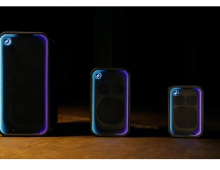
Home theater speaker configurations vary considerably. Some
enthusiasts have built upon audiophile-grade stereo systems. These systems
may have large, full-range Left and Right speakers that produce bass so deep
that any subwoofer would be extraneous. In this case, the Left and Right
speakers may well be considerably larger than the Center and Surround
speakers. Other systems may have five matching satellite speakers, plus a
subwoofer. Some systems may have no Center channel speaker. The
SCD-XA9000ES has a Digital Signal Processing (DSP) Large Scale Integrated
Circuit (LSI) to achieve optimal multi-channel reproduction with all these speaker
configurations. The DSP processes the Direct Stream Digital signal in its 1-bit
form, using technology similar to the professional editing systems currently used
in the studio to produce Super Audio CDs. The DSP accomplishes three
functions when using the analog outputs:
- Bass redirection. You can optimize the SCD-XA9000ES output to work
with your specific speaker configuration.
- Channel balance. The Sony ES player can also accommodate differences
in speaker efficiency, adjusting the balance between front/surround,
front/center and front/subwoofer speakers.
- Test tone. The SCD-XA9000ES is equipped with a test tone oscillator to
confirm connection status and channel balance adjustments.
It's easy to access these functions through the front panel menu key.
And you can make critical channel-balance adjustments from your actual
listening position, using the supplied remote control.
If you have an ideal speaker layout, you can use the Direct Mode, which
completely bypasses the DSP circuit. Other options include 2-Channel Direct
and 2-Channel Direct + Subwoofer, ideal for stereo SA-CD playback.
Engaging Multi-Channel Management selects among seven different
speaker configurations, each with adjustable channel balance.
Speaker playback mode
Sony's multi-channel management gives you seven different
bass
redirection modes, plus channel balance for fine tuning.

Simple menu keys access the different bass redirection modes.
And
you can fine-tune channel balance by remote control,
so you can make
critical adjustments from your actual listening position.
- Speaker Time Alignment
When Super Audio CD titles are mastered, the engineers create the
soundstage for an idealized home speaker configuration. In stereo, that
configuration is simple: two identical speakers set an equal distance from the
listener. With multi-channel sound, the ideal is slightly more complex.
Multi-channel Super Audio CD is designed to conform to an international
standard, called ITU-R. This envisions that the listener sits in the exact center
of a circle of five identical speakers, with each speaker occupying a specified
position in the circle. (For the Low Frequency Effects or LFE channel, the
subwoofer can be flexibly placed outside the circle.)
The ITU-R circle makes a great reference for studio engineers. But few
home environments can accommodate exactly this setup. Even if you did have
five identical speakers all the way around, the rectangular shape of most rooms
would make it difficult to place all five speakers at an equal distance from the
listening position.

Mastering for Super Audio CD multi-channel sound assumes that
speakers will be placed according to the international ITU-R standard
(left).
Unfortunately, most practical listening rooms don't match this
standard exactly.
Speaker Time Alignment applies a delay to selected
speakers to "move" them
into proper position (right). In this example,
time delay pushes back the apparent
position of the SL and SR
speakers to match the L, C and R speakers.
To resolve the problem, Sony enables you to apply a carefully timed delay
to each individual speaker. Sony provides this delay in 150-microsecond
increments. Because most people can't make the mental leap from
microseconds to speaker distance, Sony calibrates the delay as distance, in 5-cm (2-inch) increments. Each 150 microseconds of delay "moves" a speaker back
5 cm (2 inches). In this way, Speaker Time Alignment adjusts the "virtual
position" of each speaker, enabling you to synchronize the arrival time of sound
for all five speakers. You can even change the perceived distance of the
subwoofer in relation to the other speakers. With Speaker Time Alignment,
you'll experience multi-channel sound as it was meant to be heard. You'll get
the effect of perfect speaker placement, even if your actual placement is far less
than perfect!
Incidentally, this adjustment is not duplicated on most A/V receivers.
Some receivers can adjust for speaker distance on the multi-channel signals that
are decoded in the receiver itself. But most receivers offer no such adjustment
for the 5.1-channel analog inputs typically used to reproduce multi-channel Super
Audio CD. When using the analog outputs of the SCD-XA9000ES,
Multi-Channel Management and Speaker Time Alignment overcome this
limitation, providing optimized sound for a wide range of speaker configurations
and room configurations.