Sony SCD-XA9000ES
1. Introduction
Sony SCD-XA9000ES SACD Player - Page 1
 In
2003, Sony released the SCD-XA9000ES which was Sony's first Super Audio CD
player to provide an
uncompressed digital output for the Super Audio CD's Direct Stream Digital™
signal. This was an i.LINK® digital output, compatible not only with Sony's
own STR-DA9000ES receiver, but also with the latest generation of outboard
D/A converters from other high-end audio companies. This way, the Sony
SCD-XA9000ES helps deliver Super Audio CD sound with effortless clarity,
transparency, impact and presence.
For owners who will connect the player to conventional receivers and
amplifiers, Sony has equipped the SCD-XA9000ES with a Tri Power
Digital-to-Analog Converter using eighteen separate SA DAC chips that deliver
the unprecedented precision of 36 DACs. With either digital or analog outputs,
the SCD-XA9000ES establishes a new and altogether higher standard in music
reproduction.
In
2003, Sony released the SCD-XA9000ES which was Sony's first Super Audio CD
player to provide an
uncompressed digital output for the Super Audio CD's Direct Stream Digital™
signal. This was an i.LINK® digital output, compatible not only with Sony's
own STR-DA9000ES receiver, but also with the latest generation of outboard
D/A converters from other high-end audio companies. This way, the Sony
SCD-XA9000ES helps deliver Super Audio CD sound with effortless clarity,
transparency, impact and presence.
For owners who will connect the player to conventional receivers and
amplifiers, Sony has equipped the SCD-XA9000ES with a Tri Power
Digital-to-Analog Converter using eighteen separate SA DAC chips that deliver
the unprecedented precision of 36 DACs. With either digital or analog outputs,
the SCD-XA9000ES establishes a new and altogether higher standard in music
reproduction.
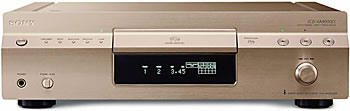
After our review on the SCD-XB790, we received from Sony a previous model, the SCD-XA9000ES, which is a hi-end device, and has has for a long time been a flagship for Sony.


click to enlarge
- Features and Specifications
- Sony's first Super Audio CD player with i.LINK® (IEEE 1394) interface digital output for the DSD signal
- Super Audio CD multi-channel and two-channel playback
- Compact Disc, CD-R, CD-RW playback
- DSD decoder LSI
- Multi-channel management with bass redirection
- Speaker time alignment
- Tri Power conversion with 36 Super Audio Digital-to-Analog Converters (SA
DACs), six per channel - Discrete dual laser optical pickup
- Twin R-Core power transformers, one for system and digital the other for
audio - Frame and Beam (FB) chassis with aluminum front panel
- Off center insulator feet