
Sony Showcases Four-layer Micro-Reflector Holographic Recording System
Sony presented the results of its latest research in the multi-layer "Micro-Reflector recording" technology, a type of holographic recording.
In the Micro-Reflector recording technology, a laser light emitted from a blue violet semiconductor laser diode is split into two so that one irradiates the front side of a volumetric optical disc medium as a reference light, while the other is emitted to the back side as a recording light. By precisely aligning the focal points of the two laser beams using servo technology, the two counter-propagating light beams focus on the same point on the disc's holographic recording material. Their interference creates a diffraction-limited size fringe corresponding to a 1 bit of information. Changing the focal points results in recording in more layers. During reproduction, light is emitted on the front side of the medium.
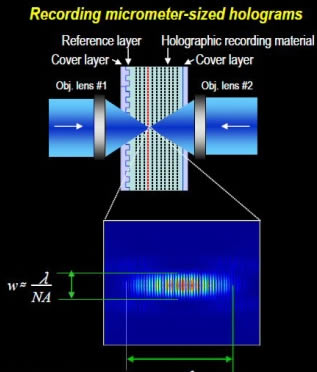
Sony claims that the Micro-Reflector recording technology poses more advantages compared to other approaches of holographic storage. The recorded interference fringes are small enough to prevent the photopolymer from expanding and contracting due to temperature changes. This eliminates the need for adjusting the wavelength of the laser in accordance with the temperature - a problem commonly faced in Holographic storage technologies. In addition, Sony's recording system can use a common, commercially available blue-violet semiconductor laser diode. The system does not require the use of other components such as spatial light modulators, CMOS sensors or other parts, making its cost lower than other Holographic recording systems.
Sony's demonstration of reading/writing operations included an optical system with a wavelength of 405 nm and a numerical aperture (NA) of 0.5. The system involves 17pp modulation, already implemented by the Blu-ray Disc. The laser had an output power of 4.5 mW / 0.5 mW for the recording/reading operations, respectively. It's rotation speed was 70rpm (CAV), and the channel clock rate was 367 KHz.
Sony recorded data on a single layer at a recording density of 1.25 GB in a 12 cm-disk. The company says that it aims to achieve multi-layer recording by increasing the numerical aperture. In order to record on all four layers, Sony added optical parts to change the focal point depth.
The volumetric optical disc comprises a 0.25 mm thick photopolymer recording layer, sandwiched between two 0.6 mm glass substrates. The 12 cm disc included four layers capable of holding up to 1.25 GB per layer. The distance between adjacent layers was 50μm.
However, Micro-Reflector multi-layer recording does not avoid the issues met in multi-layer recording systems in general. The reproduction signal gets weaker as the system tried to read the deeper layers. In addition, a slow data rate is also listed as a problem.
Sony said that it plans to solve these issues in the future to achieve a storing capacity of 500 GB using 25-layer disc. The results of Sony's research were demonstrated at ODS 2007, currently held in Portland, U.S.A.
Sony claims that the Micro-Reflector recording technology poses more advantages compared to other approaches of holographic storage. The recorded interference fringes are small enough to prevent the photopolymer from expanding and contracting due to temperature changes. This eliminates the need for adjusting the wavelength of the laser in accordance with the temperature - a problem commonly faced in Holographic storage technologies. In addition, Sony's recording system can use a common, commercially available blue-violet semiconductor laser diode. The system does not require the use of other components such as spatial light modulators, CMOS sensors or other parts, making its cost lower than other Holographic recording systems.
Sony's demonstration of reading/writing operations included an optical system with a wavelength of 405 nm and a numerical aperture (NA) of 0.5. The system involves 17pp modulation, already implemented by the Blu-ray Disc. The laser had an output power of 4.5 mW / 0.5 mW for the recording/reading operations, respectively. It's rotation speed was 70rpm (CAV), and the channel clock rate was 367 KHz.
Sony recorded data on a single layer at a recording density of 1.25 GB in a 12 cm-disk. The company says that it aims to achieve multi-layer recording by increasing the numerical aperture. In order to record on all four layers, Sony added optical parts to change the focal point depth.
The volumetric optical disc comprises a 0.25 mm thick photopolymer recording layer, sandwiched between two 0.6 mm glass substrates. The 12 cm disc included four layers capable of holding up to 1.25 GB per layer. The distance between adjacent layers was 50μm.
However, Micro-Reflector multi-layer recording does not avoid the issues met in multi-layer recording systems in general. The reproduction signal gets weaker as the system tried to read the deeper layers. In addition, a slow data rate is also listed as a problem.
Sony said that it plans to solve these issues in the future to achieve a storing capacity of 500 GB using 25-layer disc. The results of Sony's research were demonstrated at ODS 2007, currently held in Portland, U.S.A.