Halc
Posts: 60
Joined: 2/4/2002
From:
Status: offline

|
I think that's thinking the whole issue backwards.
PI/PO errors don't cause the drive to fail to read the disc. PI/PO are causal errors, that are calculated by the drives chipet, because the drive is unable to track/read/correctly detect the optically encoded analog waveform on the disc. Waveform isn't unambiguous anymore and bits become misinterpreted by the chipset.
PI/PO errors (unless intentional) should not be considered to "be" on the disc. Drives don't fail because of them, they fail due to lower level incompatibilities and the result is a rise in PI/PO rates, somtimes a complete failure to read/detect the disc at all.
Low level measures of a DVD disc, like eccentricity, vertical and radial deviation, refraction, thickness and birefringence can be considered properties of the media.
Indirect measures like asymmetry, DC jitter, reflectivity, tracking and push-pull are affected by the the low level characteristics of the media, the reading drive and the speed (and other variables) of reading process.
It is debatable whether the measured indirect properties like DC jitter (using a calibrated analyzer) are true measures of the disc or a combination of the disc/reader. Regardless, it can be said that incompatibilities between these indirect measures and the reading capabilities (tolerance margins) of the reading drive, are what cause bit level errors.
PI/PO errors are just the results of these incompatibilities.
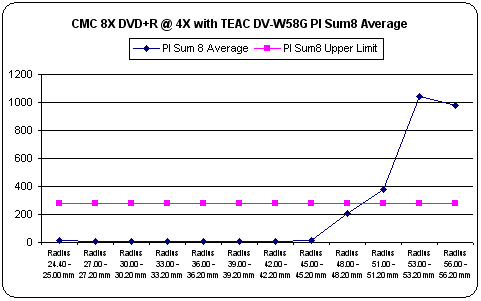
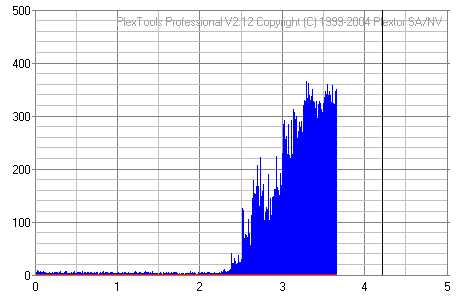
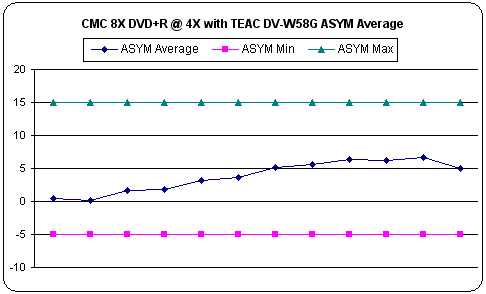
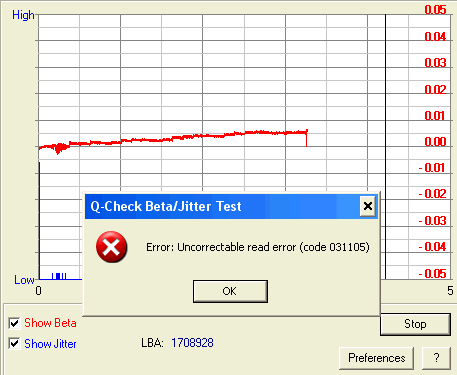
But, as you can see in Plextor failure case by studying the jitter/asymmetr/beta results, neither jitter or asymmetry rise to the level that is over the maximum that Plextor 712SA can tolerate. If you look other discs succesfully scanned by the Plextor, they have similar/higher indirect measures for jitter/asymmtery, but still Plextor reads them fine. Study the jitter/Asym readings from CATS and jitter/beta from Plextor.
So, at least those two lower level values are not what are causing the reading problems for Plextor.
There must be some other low level mismatch between the media and 712SA that the Plextor is unable to tolerate, hence the rise in PI/PO and subsequent interruption of the testing altogether.
This is precisely the reason why PI/PO scans can be very misleading, because one drive can be sensitive to jitter (and get huge PI/PO errors on jittery discs). At the same time, another another drive can be very tolerant of jitter and gives excellent PI/PO results on that same jittery disc. That second drive can however fail on tangential push-pull issues of a different bad disc and then give high PI/PO error rates for that disc.
Of course this is an oversimplification, but it illustrates the issue, I hope.
To this day I have not seen a consumer drive that is superior (to competition) in it's ability to tolerate ALL lower level problems in reading. I know already from testing done by OSTA/c't that Plextor/Pioneer/LiteOn produce drives with relatively high jitter tolerance (up to 20% max average DC jitter). But we do not know their tolerance margins for other lower level measures.
As such, I'm intrigued why does Plextor 712 fail on that scan? What indirect measures go over it's capabilities?
best regards,
halcyon
|

 You can click here to see
 Today's Posts
|
Today's Posts
|
 Most Active Topics
|
Most Active Topics
|
 Posts Since Last Visit
 Printable Version
 Plextor PX-712 PIPO vs. SA300 - Part 2 -





 New Messages
 No New Messages
 Hot Topic w/ New Messages
 Hot Topic w/o New Messages
 Locked w/ New Messages
 Locked w/o New Messages
 Post New Thread