KIOXIA Exceria Pro G2 NVME 2TB
2. Tests
In order to test the NVME drive we used the following configuration:
- CPU: AMD Ryzen 9 7950X
- Motherboard: Asus ProArt X670E-CREATOR WIFI 3902 BIOS
- Memory: 2x16GB AddLink Spider X5 DDR5-6000MHz (EXPO Profile)
- PSU: be quiet! Dark Pro 13 1300Watt
- Main Storage: Samsung 980Pro 1TB
- VGA: MSI GeForce RTX 4090 SUPRIM X 24G
- Operating system: Windows 11 x64 + latest motherboard/AMD chipset drivers installed (DirectStorage enabled drive)
The Exceria Pro G2 was installed in the PCIe Gen5 M.2 slot nearest the CPU and run as shipped, with its included heatsink in place. Across every test, the drive held its rated speeds without any thermal throttling or sustained-write slowdown — it shrugged off everything we threw at it.
We ran the 2TB unit through a full suite of synthetic and real-world tools using several generations of CrystalDiskMark, plus ATTO, TxBENCH, AS SSD, and real-world file copy tests.
| Tool | Seq Read | Seq Write |
|---|---|---|
| CrystalDiskMark 6.0.2 (Q32T1) | 14,817 MB/s | 13,332 MB/s |
| CrystalDiskMark 8.0.6 (Q8T1) | 14,796 MB/s | 13,310 MB/s |
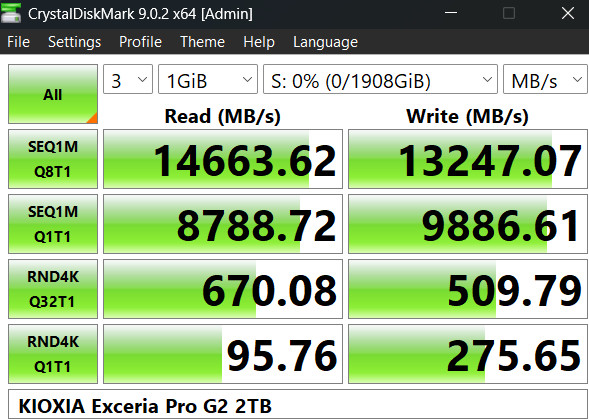
| CrystalDiskMark 9.0.2 (Q8T1) | 14,664 MB/s | 13,247 MB/s |
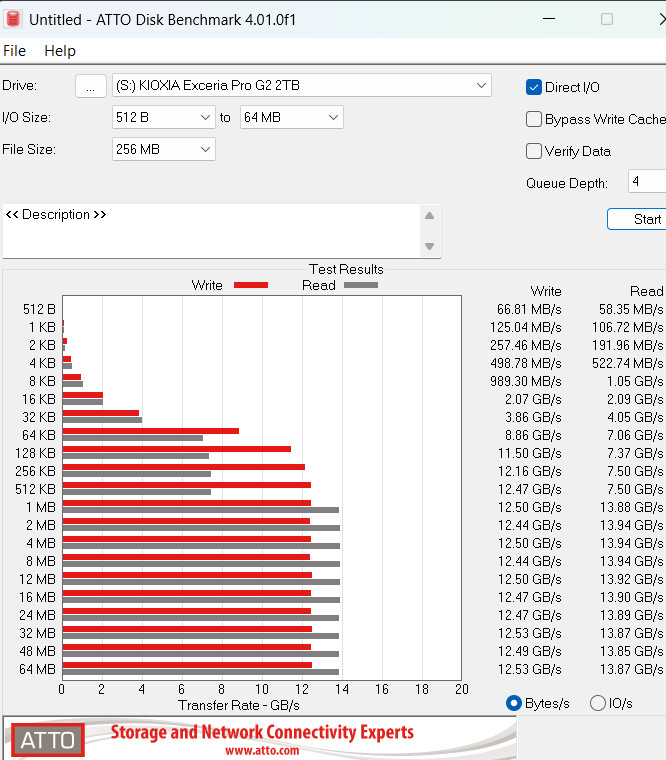
| ATTO (64MB transfer) | ~13.9 GB/s | ~12.5 GB/s |
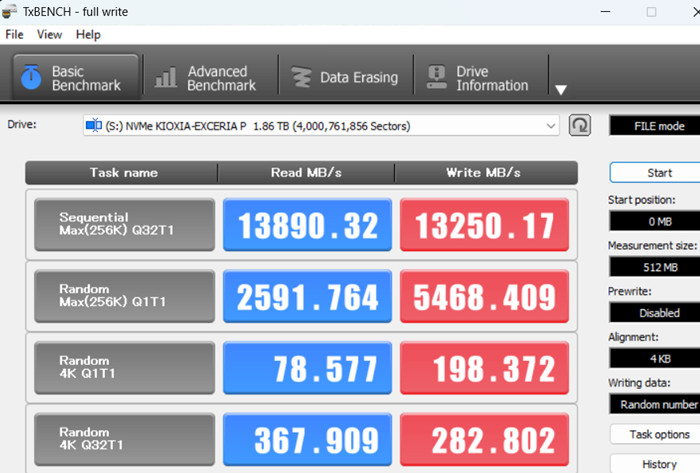
| TxBENCH Sequential Max | 13,890 MB/s | 13,250 MB/s |
| AS SSD Seq | 11,092 MB/s | 11,369 MB/s |
That's within a hair of KIOXIA's own rated 14,900/13,400 MB/s for the 2TB model on the newer CrystalDiskMark builds — CrystalDiskMark 9.0.2 in particular landed right in line with the advertised spec (KIOXIA's own listed figures are measured with CrystalDiskMark 8.0.4, Q32T1 for sequential and Q32T16 for 4KiB random). AS SSD (an older, more conservative tool) reported somewhat lower figures, which is typical of how that benchmark tends to score Gen5 drives rather than a real shortfall.
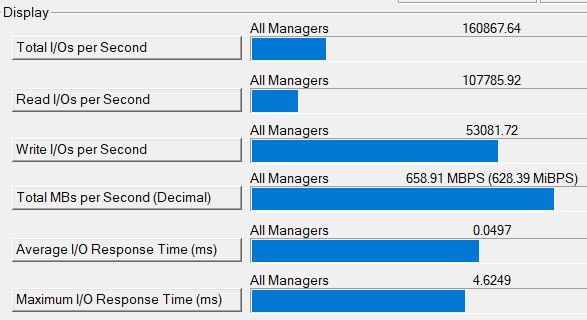
Random 4K performance was solid rather than chart-topping: CrystalDiskMark 9.0.2 posted 670 MB/s read / 510 MB/s write at Q32T1. At the I/O meter test, the drive put up a strong showing with roughly 160,867 combined IOPS (about 108,000 read / 53,000 write), and an average I/O response time around 0.05ms.
Starting our tests, we used many different CrystalDiskMark software versions to get how the drive would perform.
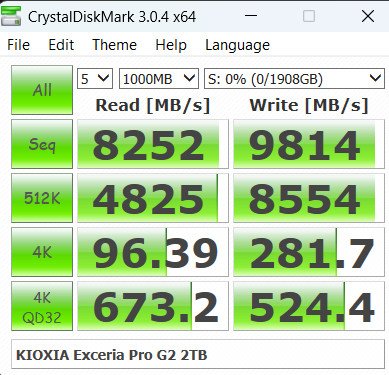
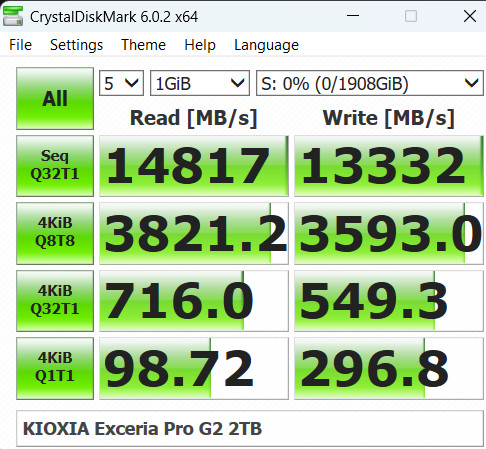
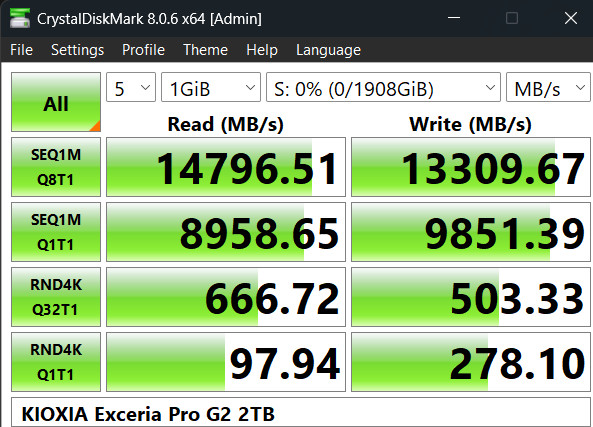
The latest CrystalDiskMark 9.0.2 promises up to 14.6GB/sec reading and 13.24GB/sec writing performance with sequential files that is according to the specs that KIOXIA advertises.
In the latest ATTO Disk Benchmark 4.01.0f1 version, we got good results, up to 13.87GB/sec reading and 12.53GB/sec writing performance.
At the I/O Meter test, the KIOXIA Exceria Pro G2 2TB NVME SSD showed top performance with 160.867 points.
More tests are available with the TxBENCH v0.96, which shows that the KIOXIA Exceria Pro G2 2TB can reach 13.890.32MB/sec reading and 13.250MB/sec writing speeds.
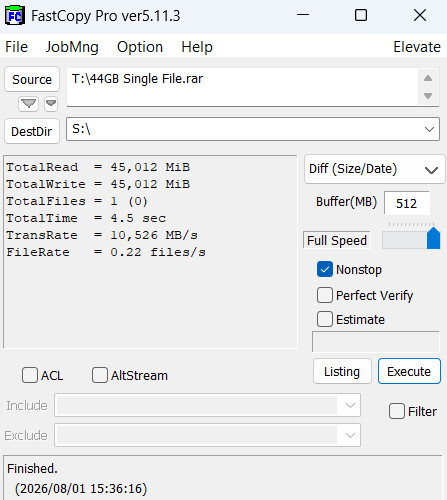
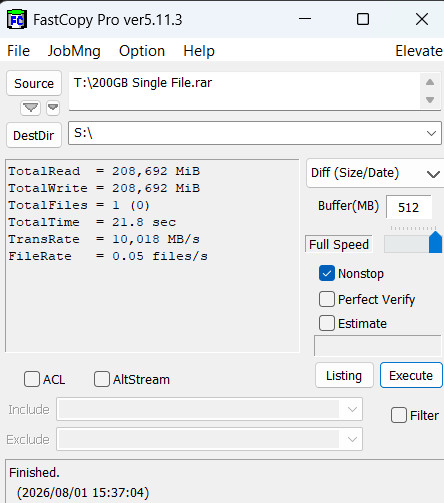
Real-world file transfers backed up the synthetics. Copying a single 44GB file with FastCopy sustained 10,526 MB/s, and a 200GB file held 10,018 MB/s across nearly 22 seconds — a good sign the drive isn't just winning on small-file cache bursts. AS SSD's copy benchmark also showed a 4,250 MB/s ISO copy in a quarter of a second and a 3,195 MB/s game-install-style copy.
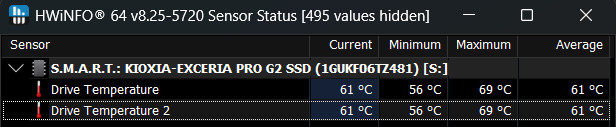
Thermals: with an active heatsink attached, HWiNFO logged a sustained drive temperature averaging 61°C (56–69°C range) during testing — warm, but well within safe operating limits, and consistent with the SM2508 controller's reputation for running cooler than earlier Gen5 controllers like the Phison E26. We feel despite the SM2508 that the drive needs either passive or active cooling
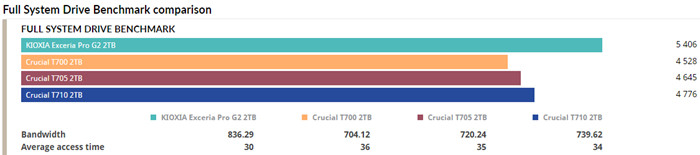
Lastly with the PCMark10 Full System drive benchmark, we can see some performance differences between the Crucial Gen5 drives. The Exceria Pro G2 2TB scored 5,406 with 836.29 MB/s effective bandwidth and a 30ms average access time — ahead of the Crucial T700 2TB (4,528 / 704 MB/s / 36ms), Crucial T705 2TB (4,645 / 720 MB/s / 35ms), and Crucial T710 2TB (4,776 / 740 MB/s / 34ms) in the same test conditions. That's a meaningful real-world edge over three well-regarded Gen5 rivals, not just a synthetic sequential win.