1. Introduction
Laserlock Marathon - Page 1
INTRODUCTION
 MLS
LaserLock International Inc. specialized in the research & development
of software protection systems and Laserlock
Marathon is the latest copy protection system from the company. Headquartered
in Thessaloniki, Greece, it was founded in 1989 and has gained worldwide
acceptance since having released the copy protection system, LaserLock.
In this review, we are going to trial how effective
LASERLOCK MARATHON protection for CDs is.
MLS
LaserLock International Inc. specialized in the research & development
of software protection systems and Laserlock
Marathon is the latest copy protection system from the company. Headquartered
in Thessaloniki, Greece, it was founded in 1989 and has gained worldwide
acceptance since having released the copy protection system, LaserLock.
In this review, we are going to trial how effective
LASERLOCK MARATHON protection for CDs is.
Laserlock Marathon Features
Laserlock offers protection against bit-to-bit copying programs, using a patented
signature on the CD and enhanced anti-debugging
and encryption techniques, which resembles a similar technology from
the Russian Star
force company.
According to the company, laserlock marathon, consists of the following features:
1. Sophisticated Code Encryption software.
2. Physical Signature on CD, made
during a unique and special glass-mastering process.
3. State-of-the-Art Debug
Prevention software engineering embedded in the software code.
Also, the new version of LaserLock offers protection that is non-generic as
each protection package is characterised by a unique locking parameter that
is specified
during
the LaserLocking procedure and provides complete protection against illegal
re-mastering and reproduction.
Test
For our tests we are going to use the Alcohol 120%, Blind write 5, Clone CD,
and Disc Dump copy software programs.
MarathonDemo CD contains one Demo MFC application
file (test.exe) and one folder (ARML2440) which includes two files (ARML2440 & ARML2440.IN).
The method we
are going to
follow is to
first create the image of the protected
demo
CD to
our
hard
disk
drive
and
then
burn
it onto
CD-R media.
Basic
hardware
specifications for our test are: Pentium 1.6GHz PC with a PlexWritter Premium
CDRW.
.
2. Alcohol 120% Tests
Laserlock Marathon - Page 2
Alcohol 120%
The well known program Alcohol 120% appears to be the ideal candidate
for testing this new protection from laserlock. Setting up the read settings,
we
use maximum
reading speed and skip reading errors. Also we enable read sub-channel data
and data position measurement (DPM) with high precision.

The program took a long time before starting to make the
image, forcing us to stop the process and change read settings, leaving
out
data postition measurement (DPM). When we cancelled the copying process, the
CD-ROM drive froze as did the entire PC, requiring us to do a hard reset on
our system.
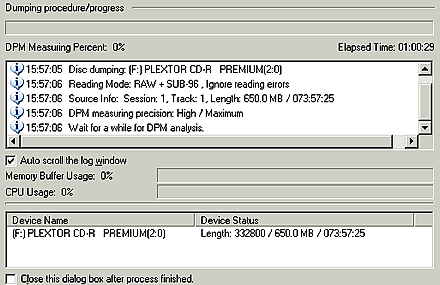
Starting over again, but now
without DPM, the program instantly starts and reaches 97%. It remained at this
point for an unusually long time. Hence,
we cancelle
our attempt once again. This may simply be a case of waiting for a really
long time to finish the process succesfully.

Lets move on to Blind Write.
3. Blind Write 4.5.4.45 / CloneCD 4.3.2.2 Tests
Laserlock Marathon - Page 3
Blind Write 4.5.4.45
 Using
Blind Write v4.5.4.45, we chose to dump the image of the CDROM to our hard
disk drive. We will be using the nibble extraction method with adapted speed
of 1x minimum. The process started immediately, using the maximum reading
speed but before
the end, started decreasing little by little down to the lower speeds. Also,
as the speed decreases, the elapsed time increases to an unknown limit. Again
we decided
to stop the process and change read setting.
Using
Blind Write v4.5.4.45, we chose to dump the image of the CDROM to our hard
disk drive. We will be using the nibble extraction method with adapted speed
of 1x minimum. The process started immediately, using the maximum reading
speed but before
the end, started decreasing little by little down to the lower speeds. Also,
as the speed decreases, the elapsed time increases to an unknown limit. Again
we decided
to stop the process and change read setting.

Choosing multiple
gaps and setting 4x minimum adapted speed, we started the reading procedure
again, hoping for better results.
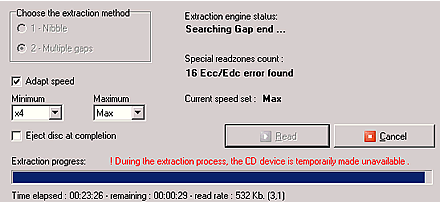
Same results with this attempt, with the speed
decreasing little by little (below 4x) and elapsed time increasing. Lets have
a try with
Clone CD.
Clone CD 4.3.2.2
 Clone
CD is another well known and very usefull burning clone tool. Together with
Alcoholer 4.1 profiler, it gives us the ability to change read settings
according to our needs.
We switched on reading sub-channel data and fast error skip, put intelligent
bad sector scanner to 100 and then started the reading process.
Clone
CD is another well known and very usefull burning clone tool. Together with
Alcoholer 4.1 profiler, it gives us the ability to change read settings
according to our needs.
We switched on reading sub-channel data and fast error skip, put intelligent
bad sector scanner to 100 and then started the reading process.

Unfortunately Clone
CD and the drive freeze at 97%, forcing us to restart the system and
move on.

Setting "read sub-channel
data" and "abort on any read error" on, as well as "fast error read" off,
we made one more try with clone CD, just to see where the problem lies.

At 97% we took the
number of the first bad sector, which was 323259.

4. DiscDump v1.10
Laserlock Marathon - Page 4
DiscDump v1.10
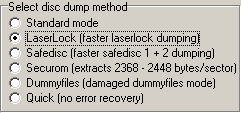 Disc
Dump, as the name says, is a dump copier which just copies what
it sees. Setting up the advanced setting to full index and max CD speed at 4x,
we started copying, selecting the Laserlock disc dump method.
Disc
Dump, as the name says, is a dump copier which just copies what
it sees. Setting up the advanced setting to full index and max CD speed at 4x,
we started copying, selecting the Laserlock disc dump method.

DiscDump starts its process immediately, reading about
690 kB/sec at 4x speed.

Unfortunatelly, it was also unsuccessful,
hovering at 97%-98% for more than two hours doing cycled read tries
at the same sectors,
where it
found more
than
100
rings trying to pass the authentication rings.

5. Conclusion
Laserlock Marathon - Page 4
Conclusion
The Laserlock Marathon Demo CD demonstrated a strong copy
protection method. The basic principle is in the authentication rings located
on the outer edge of the CD,
which didn`t allow the copy process to finish. The majority of the
clone burning programs were unsuccessful for this reason. With Clone CD
and Disc Dump, we observed that the first bad sector was at 323259.
At this point,
the reading process behaved in a strange way, reading the same sectors many
times, moving on and then going back to do the same again and again,
having a really slow
reading
speed of less than 1x.
MLS
uses a large number of rings on the outer side of the CD where they enforce
a cycled reading procedure between specific sectors
and then spinning down the motor of the drive as there are data errors causing
cyclic redundancy checks. Hence, reading can`t pass the specific sectors and
therefore
cannot finish the copy procedure.
There
is a possibility that the Marathon protection scheme can be cracked, by running
an ink marker round
the outer edge of the CD, thus by-passing
it's
protection, but this probably won`t work because the physical signature
on the CD should not be lost as the executable file is going to check for
it, and if that is not the case, copiers have a large area full of
errors on the CD to copy,
which means that
they are going to
need
a long time for one copy.
Laserlock
recommends the locking process be carried out at their company's
labs, where they "inject" the laserlock system
in the main executable file, producing a new protected executable
file
that contains the original and the laserlock system. The Laserlock system
occupies an extra 20 MB for CDs and 35 MB for DVDs. This method is recommended
by MLS and does not require any additional programming from the customer.
Nowadays, MLS lacerlock cooperates with many of the CD-ROM manufacturing companies
globally,
like Sonopress, MPO, Saturn, Media Solutions e.t.c.
There is one question regarding protected CDs that we would like
to pose. While it is certainly illegal to make copies for redistribution, it
is not necessarily
illegal to
make backups for safe keeping (should the original be damaged or produce errors
due to use). In this case, there is no way for the owner of the disc to bypass
the Laserlock protection scheme.
|
Advertising |

|