
Intel Show off Future Research Concepts
A sneak peek of tomorrow was provided by Intel today at the company's annual Research@Intel Day. Nearly 40 futuristic projects and concepts were showcased in such areas as eco-technology, 3-D Internet, enterprise IT and wireless mobility.
Intel also has a made public a beta Web site where users can play "point, counterpoint" by submitting a statement found online and learning whether he or she has been duped.
Two researchers on hand included Ajay Bhatt, the co-inventor of USB, the standard to connect devices to computers, and Joshua Smith, a pioneer in wireless power and robotics. Both are currently featured in a new commercial called "Rock Star," which is part of the company's current Sponsors of Tomorrow marketing campaign.
"I hope attendees get a chance to speak with and meet our very own rock stars from Intel Labs today," said Justin Rattner, Intel's chief technology officer. "What the researchers are developing today in the labs will ultimately make future computing and communications faster, easier and more energy efficient, and have a significant impact on people's work and home life in the coming years."
Rattner, also an Intel Senior Fellow and vice president and director of Intel Labs, discussed recent changes to Intel's research agendas and priorities. The goal is to improve the likelihood of impact and tightly align with the company's overall growth vectors such as mobility, visual computing and system-on-chip design, where many more computing and communications functions are placed on a single piece of silicon. The new organization, called Intel Labs, will identify game-changing opportunities for tech innovation and deliver breakthrough discoveries in those areas.
Several of these research innovations were on display at the event. Demonstrations covered power efficiency for mobile devices, immersive connected experiences, mobility and enterprise IT.
Future Intel Atom processor-based MIDs and Smartphones to Implement New Technique from Labs
 Platform power management (PPM), a research effort first discussed in this same forum last year, is one of the new power management technologies behind "Moorestown," the codename of a future member of the Atom family that targets mobile Internet devices (MIDs). Rattner was joined onstage by Ticky Thakkar, Intel Fellow and director of platform architecture for the Ultra Mobile Group, to disclose that this research has helped enable up to a 50x reduction in platform idle power over today's Atom-based platform, which translates to much longer battery life.
The power reduction technique is a fundamentally new approach that introduces changes to silicon for enabling hardware to play a major role in reducing power consumption. In this new approach, hardware implements power policies set by the operating system to manage power in much less time and at much finer granularity. The computer will be able to intelligently reduce power or even power down portions of the system not in use ? as with wireless radios or I/O subsystems -- and immediately power back on when needed with zero impact to the user experience. Platform power management could someday benefit the full range of Intel products, from MIDs to high-performance servers.
Dispute Finder: Are You Being Duped?
"The Web" is nearly synonymous with "information." While much of this information is useful, a significant amount could be characterized as false, misleading or biased. Dispute finder is an early research effort from Intel Labs that enables Internet surfers to navigate through a minefield of contradicting information much easier.
While a user is reading an online news article, blog or Web site, text snippets are automatically highlighted if information found elsewhere contradicts a given claim made. Clicking on the highlighted snippet, like "a glass of wine a day is good for you," reveals an argument graph showing sources on either side of the issue. Every single claim and evidence has been user generated, similar to how Wikipedia works, and are maintained in a central venue online where anyone can contribute.
Future of the Internet: Much Less Text
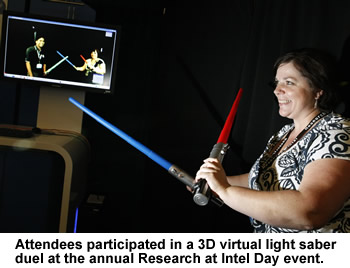 As future Intel chips scale from a few cores to many, researchers at Intel Labs believe the transition to mainstream parallel computing will lead to a future Internet that is rich in 3-D graphics and relies a lot less on text, making possible a more immersive Internet experience with ultra-realistic 3-D visualizations and natural human-computer interfaces. Picture a travel Web site that allows you to check out your vacation destination, like New York City, before you actually get there. So in addition to a virtual walk around the hotel room, users could also check out Times Square, restaurants, nearby theaters and even walk the route to estimate how far they are from the hotel.
Intel has begun prototyping the 3-D Internet in the scientific world first, using a tool called ScienceSim. This is a common place on the net where scientists can create visual simulations online and collaborate more effectively using these capabilities. The idea is to advance research through visualization, like a model of coastal margins and tides in order to study the impacts of human activity.
Creating a More Flexible Internet, Running on a General Purpose Computer
The Internet's original designers never anticipated its astounding growth and success. Consequently, the Internet relies on highly specialized network equipment often with hard coded support for a pre-defined set of packet routing capabilities. This presents challenges given the rapidly evolving demands of new applications. Intel researchers propose Router Bricks as a simple, but radical solution, allowing networks to be built from general-purpose computers rather than specialized equipment. The prototype demonstrated builds a high-speed router from clusters of the latest Intel-based servers running open-source software. Rather than wait years for specialized routing hardware to evolve, network programmers in the future could cheaply and rapidly program new router functions using the familiar general purpose computer as their platform.
Two researchers on hand included Ajay Bhatt, the co-inventor of USB, the standard to connect devices to computers, and Joshua Smith, a pioneer in wireless power and robotics. Both are currently featured in a new commercial called "Rock Star," which is part of the company's current Sponsors of Tomorrow marketing campaign.
"I hope attendees get a chance to speak with and meet our very own rock stars from Intel Labs today," said Justin Rattner, Intel's chief technology officer. "What the researchers are developing today in the labs will ultimately make future computing and communications faster, easier and more energy efficient, and have a significant impact on people's work and home life in the coming years."
Rattner, also an Intel Senior Fellow and vice president and director of Intel Labs, discussed recent changes to Intel's research agendas and priorities. The goal is to improve the likelihood of impact and tightly align with the company's overall growth vectors such as mobility, visual computing and system-on-chip design, where many more computing and communications functions are placed on a single piece of silicon. The new organization, called Intel Labs, will identify game-changing opportunities for tech innovation and deliver breakthrough discoveries in those areas.
Several of these research innovations were on display at the event. Demonstrations covered power efficiency for mobile devices, immersive connected experiences, mobility and enterprise IT.
Future Intel Atom processor-based MIDs and Smartphones to Implement New Technique from Labs
Platform power management (PPM), a research effort first discussed in this same forum last year, is one of the new power management technologies behind "Moorestown," the codename of a future member of the Atom family that targets mobile Internet devices (MIDs). Rattner was joined onstage by Ticky Thakkar, Intel Fellow and director of platform architecture for the Ultra Mobile Group, to disclose that this research has helped enable up to a 50x reduction in platform idle power over today's Atom-based platform, which translates to much longer battery life.
The power reduction technique is a fundamentally new approach that introduces changes to silicon for enabling hardware to play a major role in reducing power consumption. In this new approach, hardware implements power policies set by the operating system to manage power in much less time and at much finer granularity. The computer will be able to intelligently reduce power or even power down portions of the system not in use ? as with wireless radios or I/O subsystems -- and immediately power back on when needed with zero impact to the user experience. Platform power management could someday benefit the full range of Intel products, from MIDs to high-performance servers.
Dispute Finder: Are You Being Duped?
"The Web" is nearly synonymous with "information." While much of this information is useful, a significant amount could be characterized as false, misleading or biased. Dispute finder is an early research effort from Intel Labs that enables Internet surfers to navigate through a minefield of contradicting information much easier.
While a user is reading an online news article, blog or Web site, text snippets are automatically highlighted if information found elsewhere contradicts a given claim made. Clicking on the highlighted snippet, like "a glass of wine a day is good for you," reveals an argument graph showing sources on either side of the issue. Every single claim and evidence has been user generated, similar to how Wikipedia works, and are maintained in a central venue online where anyone can contribute.
Future of the Internet: Much Less Text
As future Intel chips scale from a few cores to many, researchers at Intel Labs believe the transition to mainstream parallel computing will lead to a future Internet that is rich in 3-D graphics and relies a lot less on text, making possible a more immersive Internet experience with ultra-realistic 3-D visualizations and natural human-computer interfaces. Picture a travel Web site that allows you to check out your vacation destination, like New York City, before you actually get there. So in addition to a virtual walk around the hotel room, users could also check out Times Square, restaurants, nearby theaters and even walk the route to estimate how far they are from the hotel.
Intel has begun prototyping the 3-D Internet in the scientific world first, using a tool called ScienceSim. This is a common place on the net where scientists can create visual simulations online and collaborate more effectively using these capabilities. The idea is to advance research through visualization, like a model of coastal margins and tides in order to study the impacts of human activity.
Creating a More Flexible Internet, Running on a General Purpose Computer
The Internet's original designers never anticipated its astounding growth and success. Consequently, the Internet relies on highly specialized network equipment often with hard coded support for a pre-defined set of packet routing capabilities. This presents challenges given the rapidly evolving demands of new applications. Intel researchers propose Router Bricks as a simple, but radical solution, allowing networks to be built from general-purpose computers rather than specialized equipment. The prototype demonstrated builds a high-speed router from clusters of the latest Intel-based servers running open-source software. Rather than wait years for specialized routing hardware to evolve, network programmers in the future could cheaply and rapidly program new router functions using the familiar general purpose computer as their platform.