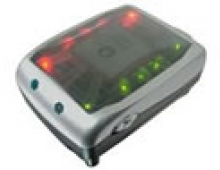
Haicom 305-III
1. Introduction
 Haicom is a leading company in the GPS arena, offering Bluetooth and CompactFlash (CF) GPS devices geared for specific user groups. Haicom kindly offered us the chance to test the Haicom 305III and compare it with another well known device from rival Globalsat, the BC-337. Which CF GPS receiver performed better and which offers more? Read on to find out!
- Haicom 305III
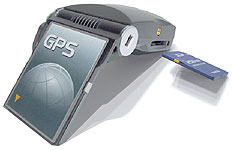 The HI-305III is a GPS receiver with Compact Flash type I / mini-1394 interfaces and built-in active antenna for high sensitivity to tracking signal. It is based on the SiRF star III Ultra high sensitive chipset and supports all functions (Single Sat updates in reduced visibility, Superior urban canyon performance, Foliage Lock for weak signal tracking, etc.).
The HI-305III is well suited to system integration and for users who use any kinds of mobile devices, such as PDAs, notebook PCs, Tablet PCs, etc. It satisfies a wide variety of applications for car navigation, personal navigation or touring devices, tracking and marine navigation purposes. Users can simply plug it into a PDA or other type of handheld PC running suitable mapping and routing software for navigation.
- Used chipset
The SiRF III chipset has the following specifications:
| Chipset: | SiRF Star III WAAS enabled |
| Frequency: | 1, 1575.42 MHz |
| C/A code: | 1.023 MHz chip rate |
| Channels: | 20 channel all-in-view tracking |
| Position Accuracy: | 10 meters, 2D RMS |
| ~ 5 meters, 3D RMS WAAS | |
| Velocity: | 0.1 m/s |
| Time: | us synchronized to GPS time |
| Default: | WGS-84 Acquisition Time (Open sky, stationary) |
| Reacquisition: | 0.1 sec., average |
| Hot start: | 1 sec., average |
| Warm start: | 38 sec., average |
| Cold start: | 42 sec., average |
| Altitude: | 18,000 meters (60,000 feet) max. |
| Velocity: | 515 meters/second (1000 knots) max. |
| Acceleration: | Less than 4g |
| Jerk: | 20 m/sec |
| Protocol messages: | NMEA-0183 output protocol |
| Output format: | GGA(1sec), GSA(5sec), GSV(5sec), RMC(1sec),VTG(1sec) |
| Operating temperature: | -20° to 60° C |
| Humidity: | 5% to 95% Non-condensing |

Looking at the SiRF III specs, we can see that the chipset is capable of receiving up to 20 satellites (actually 12 maximum), has very low Hot/Warm/Cold start times and its accuracy reaches ~5m when the WAAS mode is enabled.