1. Features. specs, package
 The Nvidia 8800 series was a big success for
Nvidia. The recent update of the G92 GPU
bring us the GeForce 8800 GTS with 512 MB of memory that
promises high performance at an affordable price. The
prices of the new cards ranging from $299 to $349 and their
most noticeable update is the support for the new PCI Express 2.0 and the
inclusion of the Nvidia's second-generation PureVideo HD engine.
The Nvidia 8800 series was a big success for
Nvidia. The recent update of the G92 GPU
bring us the GeForce 8800 GTS with 512 MB of memory that
promises high performance at an affordable price. The
prices of the new cards ranging from $299 to $349 and their
most noticeable update is the support for the new PCI Express 2.0 and the
inclusion of the Nvidia's second-generation PureVideo HD engine.
Asus has prepared an enhanced version based on the 8800GTS series with increased core/shaders/memory clocks. In short the AsusEN8800GTS 512 Top is 7% faster than a generic GeForce 8800GTS 512M and supports ASUS's Smart Doctor: Shader Clock overclocking and intelligent hardware protection tool and ASUS's Gamer OSD.
- Retail package
The Asus EN8800GTS Top comes with a relatively small retail package, also met in many other Asus graphics cards. The "7% Faster" logo looks teasing to all those overclocking enthusiasts.

Inside the box, everything is well organized.

We can find a DVI to D-Sub adaptor, an HDTV-out cable and a Power cable. There is also an optical disc with drivers and utilities. Don't expect to find any retail game :)
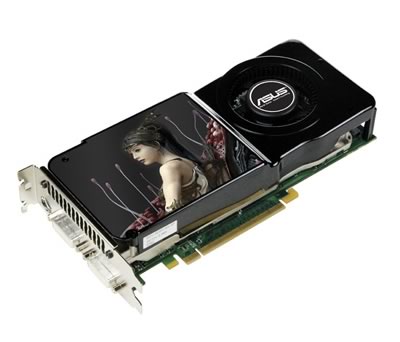
The Asus EN8800GTS Top uses Nvidia's reference cooling solution with a dual slot design.
The length of the board is 23cm posing some possible issues with crammed cases.


A 6-pin power connector should be used in order to properly power up the graphics card.

The GPU core runs
at 740MHz, memory is clocked at 1035MHz while the Shader clock is set at 1800MHz.
Hopefully this baby will further overclock as we will find out later in the tests. Below there are are several screenshots from GPU-Z and Everest Ultimate Edition.


- Specifications
Graphics Engine |
NVIDIA GeForce 8800GTS
|
Bus Standard |
PCI Express 2.0 |
Video Memory |
DDR3 512MB |
Engine Clock |
740 MHz |
Memory Clock |
2070 MHz ( 1035 MHz DDR3 ) |
Memory Interface |
256-bit |
DVI Max Resolution |
2560 x 1600 |
D-Sub Output |
Yes x 1 (via DVI to D-Sub adaptor x 1 )
|
DVI Output |
Yes x 2 (DVI-I) |
HDTV Output (YPbPr) |
Yes |
HDCP Support |
Yes |
TV Output |
Yes (S-Video to Composite)
|
Adapter/Cable Bundled |
1 x DVI to D-Sub adaptor
1 x HDTV-out cable
1 x Power cable
|
Software Bundled |
ASUS Utilities & Driver
|
Note |
The card size is 4.376 inches x 9 inches |
2. Tests and setup
All tests were conducted in the following PC:
- Motherboard: Asus Stiker II Extreme Bios 603 (Nvidia 790i Ultra SLI)
- Processor: Intel Q9300
- Case: Open Air testbed
- Power Supply: OCZ GameXStream GXS600 SLI-Ready
- Memory: 2x1GB Supertalent DDR3-1600 (1333MHz@ 7-7-7-20-1T)
- HDD: WD 200JB 7200RPM
- Monitor: LG L246WH-BH 24"
- Windows VISTA SP1 32bit with all the latest updates installed
- DirectX March 2008
- Nvidia Forceware series v175.63 with High Quality setting.
This is the test bed we have used for the benchmarks of all the graphics cards we present in the following comparison charts. Different games and applications were used for the evaluation of the performance of each graphics card. FRAPS software was also used when needed.
DirectX 9
- 3DMark 05 v1.2.0
- 3DMark 06 v1.1.0
- Half Life 2: Episode 2
DirectX10
- 3DMark Vantage v1.00
- Company Of Heroes v1.7.1
- Crysis v1.2.0 Retail
- Assasins Creed v1.00 retail
3. Testbed DirectX9, DirectX10
- Testbed DirectX9
For all the tests we used the default settings of 3DMark05 as following:

Again we left all the default settings:


- Testbed DirectX10
- 3DMark Vantage v1.0.0
- Company Of Heroes (v1.7.1)

We used the benchmark with all details maxed out.

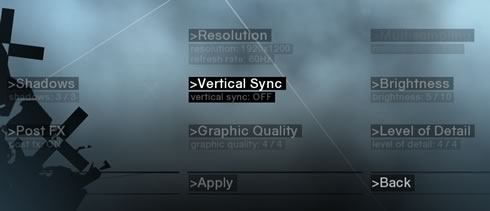
We used the hocbench Crysis benchmark tool for three resolutions, 1280x1024, 1680x1050 and finally 1920x1200. We ran the benchmark software with High and Very High details set, in order to find out the max playable resolution.
We maxed out all visual details, including 4x AA Multisampling and of course 16x AF. We used FRAPS to record the game-in experience after recording a two minutes runout.
4. FutureMark Hall Of Fame
The Futuremark benchmarks have been highly discussed between gamers and reviewers. For your information we post results from 3DMark 05, 3DMark 06 and of course the newly released 3DMark Vantage that gives you a rough idea of what can you expect from the tested graphics cards.

The higher core/memory/shader clocks affects the overall 3D Mark 05 and 3DMark 06 scores, compared with the XFX 8800GTS 512 Alpha Dog Edition.

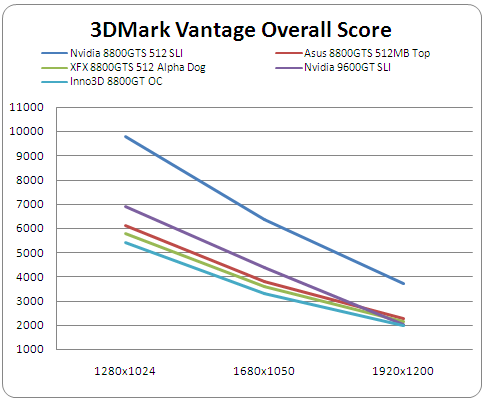
Passing to 3DMark Vantage, we have a clearer view about the card's performance in various resolutions, starting from 1280x1024 and up to 1920x1200. The Asus EN8800GTS 512 Top is faster than the XFX 8800GTS 512 Alpha Dog Edition at 1280x1024 but at the highest 1920x1200 resolution, both cards performed nevertheless the same. An Nvidia 8800GTS 512MB SLI combo seems to perform very well giving very high scores.
5. Crysis (DirectX10)
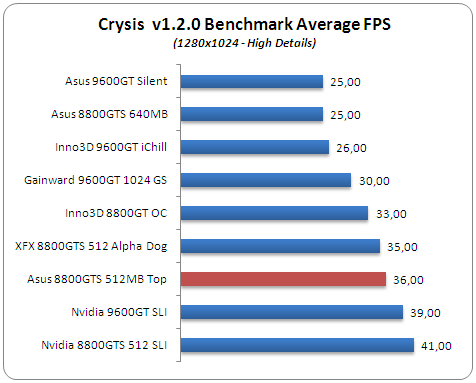
Crysis is probably the defacto benchmark game since almost no currently sold card can offer acceptable frame rates, especially under high quality settings . All tested graphics cards offer acceptable frame rates at 1280x1024 and high quality settings set. The Asus EN8800GTS 512 Top is just one FPS faster than the XFX 8800GTS Alpha Dog, at least looking at the overall average rates. The 8800GTS 512 SLI combo gives you additional 5 FPS.
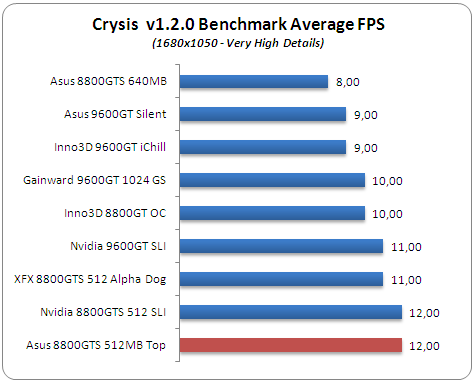
Enabling the very high quality settings has a 50% impact on the performance of each tested graphics card. The two 8800GTS 512MB cards gave exactly the same performance, and even the 8800GTS 512 SLI combo doesn't seem to offer much more in this case....

Pushing resolutions even higher at 1680x1050 and 19200x1200 the game is not playable - always with very high quality settings.

6. Company Of Heroes v1.71 (DirectX 10)
Company Of Heroes is a popular action/strategy game with many fans around the world. The game has been the first to take advantage of the DirectX10 and the game physics are very impressive. We maxed out all visual details and with the build-in benchmark we measured the performance of each card.

At 1280x1024, the average performance of all tested video cards is very good. The Asus EN8800GTS 512 Top gave us some additional five (5) FPS compared with XFX 8800GTS 512 Alpha Dog Edition. The two 8800GTS 512 gave an impressive 110FPS.
Continuing with the 1680x1050 and 1920x1200 resolutions, the performance differences are smaller, but worth mention.


7. Assassins Creed (DirectX 10), Half Life 2 Episode 2 (DirectX 9)
- Assassins Creed (DirectX 10)
Ubisoft's Assassins Creed supports the DirectX 10.1 extensions. The game is highly demanding, especially with all details maxed out. We tested the graphics cards at 1920x1200 resolution only, since lower resolutions have very high frame rates. Using FRAPS we recorded the same fight scene and the game results are presented below.

The Asus EN88800GTS 512 is faster by just one FPS compared with the XFX 8800GTS 512 Alpha Dog model. The combination of the two cards gives a high performance of 51.20FPS.
- Half Life 2 Episode 2 (DirectX 9)
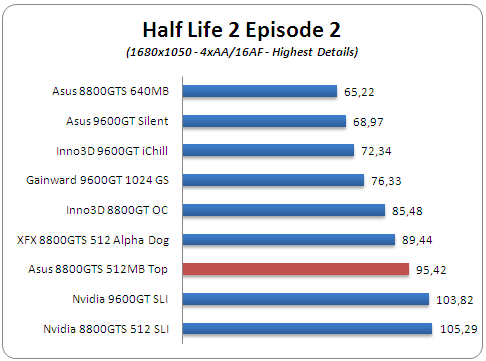
Half Life 2 is a first person shooter game that everybody has played and loved. The game at Episode 2 has several image quality improvements. By enabling 4xAA and 16AF we have a significant visual improvement.
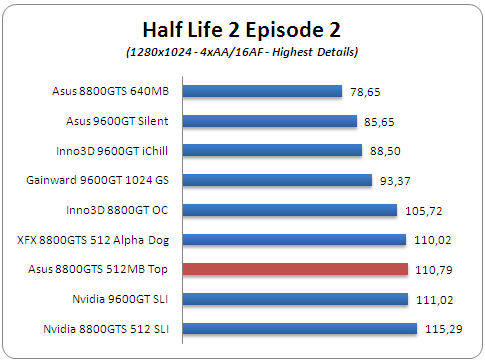
The Asus EN8800GTS 512MB Top gave a 7~9FPS more than its biggest competitor, the XFX 8800 512 Alpha Dog Edition, in the 1920x1200 resolution.

8. Overclocking/Noise/Heat - Final Words
- Overclocking/Noise/Heat
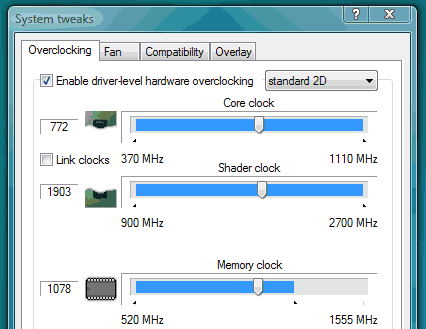
Overclocking a graphics card could be a very easy task, depending the existing cooling system and the native core/memory frequencies. The Asus EN8800GTS 512 Top is already pre-overclocked compared with a generic Nvidia 8800GTS 512MB model. We were curious to see what would be the limits of the card, which can be found with a trial-error testing procedure. We used the latest RivaTuner software and we rised up core/memory/shader frequencies until we got an error-free 3 round crysis benchmark.
Graphics Card |
Core |
Memory |
Shader |
Normal |
OC |
Normal |
OC |
Normal |
OC |
Asus 8800GTS Top |
740 |
772 |
1035 |
1078 |
1800 |
1903 |
We managed to get some extra performance boost from the Asus 8800GTS Top, but not as much as we hoped. Perhaps with a different cooling system, this overclocking gain would be higher...
Looking at the core temperatures, we see that at idle mode, we have around 69 Celcious, that can read around 79 celcious under load.

- Conclusion
Asus has a long tradition in producing overclockable products based on Nvidia's designs. The Asus EN8800GTS 512 Top comes with 7% higher clocks than generic Nvidia 8800GTS 512 cards and this should be enough to give you a higher performance compared to the majority of the currently sold 8800GTS 512MB implementations.
Our tests confirmed that higher clocks mean higher performance, at least in most cases.
Overall we have no problem suggesting the Asus EN 8800GTS Top card to anyone who wish a fast and reliable solution at the retail price of ~ 260 Euro. The generic EN 8800GTS costs 50 euro less. Does this card deserve the extra spending? Well, if you are one of those who can't live without some extra boost, you are always seeking for the absolute benchmark scores and can't do without having the best performer in its category, then the Asus EN 8800GTS Top is your choice. If not, then the 50 euro saving would allow you to discuss about graphics cards with your friends over some beers.