1. Introduction
 Asus, as an innovative manufacturer of PC peripherals, decided to enter a rather unusual arena when it announced a line of new sound cards. As we all know, this territory has been "dominated" by Creative Labs with their famous SoundBlaster series, while almost all currently sold motherboards support up to 7.1 surround sound. The Asus Xonar D2 comes with good specifications, but it not only has to compete with the already established "SoundBlaster" series, but also many professional sound cards in this category.
So what can we expect from the Asus Xonar D2?
- Asus Xonar D2
The ASUS Xonar D2 audio card series was announced at this year's (2007) Computex Taiwan. The Xonar D2 7.1-channel audio card made an impact among users and the press, since another company, besides Creative Labs, has decided to enter this rather "difficult" market.
Asus uses its own design, based on the AV200 audio chip, which, according to Asus "...not only provides unprecedented sound quality on PC platform, but also integrates multiple sound-enhancing technologies from Dolby® and DTS to transform almost any PC into a high-quality digital home media center..."
The ASUS Xonar D2 features a signal- to-noise ratio (SNR) of 118 db for both audio in and out—reaching the limit of audio quality on most PC platforms. Unlike generic sound cards on the market that provide the highest SNR to only the front stereo outputs, the Xonar D2 is able to deliver 118 db quality audio for all 7.1 channels.

Apart from delivering impressive audio quality, the Xonar D2 is also packed with multiple sound technologies from Dolby and DTS to deliver outstanding entertainment experiences. These include Dolby Digital Live, which converts PC or game audio content real-time into Dolby Digital; Dolby Headphone, which creates an entertaining surround sound listening experience using any set of headphones; Dolby Virtual Speaker, which delivers a vibrant surround sound listening experience from stereo speakers and Dolby Pro Logic® IIx, which creates up to 7.1-channel surround from stereo or 5.1 sources as well as DTS Interactive for real time AC-3 encoding and DTS NEP: PC stereo to multi-channel expander.
"As users increasingly use their PCs to enjoy music, movies, and gaming, great audio is key to delivering an outstanding entertainment experience," said Greg Rodehau, PC Market Segment Director, Dolby Laboratories. "The ASUS Xonar D2 sound card delivers a powerful suite of Dolby technologies that create highly immersive listening environments from virtually any content or playback device being used."

The technologies onboard the Xonar D2 deliver outstanding game audio quality and 3D positioning in PC 3D games. DirectX technology specifies and creates 3D positions of sounds around the player for 4, 5.1, or 7.1 speaker configurations.
The Xonar D2 also comes with a special application called "Portable Media Processor". This application works with the onboard ALT (Analog Loopback Transformation) circuit to provide almost lossless analog recording audio quality from digital music files.
To sum up, the ASUS Xonar D2 is a new generation audio card that focuses on providing audio lovers with truly high end audio quality, for gamers the best 3D positioning sound effects, and adds more value for everyone who wants to have better music experience on the go.
- Features
The main features are:
- Unprecedented SNR Up to 118db reaching the limit of PC sound clarity
- High-definition audio processing at 192KHz/24Bit for all Input and outputs
- Versatile Dolby/DTS Audio Technologies for Game, Music, and Video
- Accurate 3D sound positioning and hardware acceleration for PC gaming
- Legally backup your digital music with Dolby Headphone or Dolby Virtual Speaker effects added
- Real-time DDL and DTS Connect encoders for amazing gaming and surround sounds over your Home Theater System

- Full specifications
Audio Performance |
Output Signal-to-Noise Ratio (A-Weighted):
118 dB
Input Signal-to-Noise Ratio (A-Weighted):
118 dB
Output THD+N at 1kHz:
0.0004% (-108dB)
Input THD+N at 1kHz:
0.0004% (-108dB)
Frequency Response (-3dB, 24-bit/96kHz input):
<10Hz to 46kHz (for all channels)
Frequency Response (-3dB, 24-bit/192kHz input):
<10Hz to 90kHz (for all channels)
Output/Input Full-Scale Voltage
2 Vrms (5.65 Vp-p)
Sample Rate Conversion Quality:
Almost lossless, high-fidelity floating-point filters, which has:
-140dB THD+N (typical value for 44.1K->48KHz, 24bit)
-145dB Dynamic Range (typical value for 44.1K->48KHz, 24bit)
|
Main Chipset |
Audio Processor:
ASUS AV200 High-Definition Sound Processor (Max. 192KHz/24bit)
24-bit D-A Converter of Digital Sources:
Burr-Brown PCM1796 *4 (123dB SNR, Max. 192kHz/24bit)
24-bit A-D Converter for Analog Inputs:
Cirrus-Logic CS5381* 1 (120dB SNR, Max. 192kHz/24bit)
|
Sample Rate and Resolution |
Analog Playback Sample Rate and Resolution:
44.1K/48K/96K/192KHz @ 16/24bit
Analog Recording Sample Rate and Resolution:
44.1K/48K/96K/192KHz @ 16/24bit
S/PDIF Digital Output:
44.1K/48K/96K/192KHz @ 16/24bit ,Dolby Digital, DTS, WMA-Pro
S/PDIF Digital Input:
44.1K/48K/96K/192KHz @ 16/24bit
ASIO 2.0 Driver Support:
44.1K/48K/96K/192KHz @ 16/24bit
|
I/O Ports |
Analog Output Jack:
3.50mm mini jack *4 (Front/Side/Center-Subwoofer/Back)
Analog Input Jack:
3.50mm mini jack *2 (Line-In/Mic-In)
Other line-level analog input (for CD-IN/TV Tuner):
CD-In, Aux-In (4-pin header on the card)
Digital S/PDIF Output:
Coaxial and High-bandwidth Optical Combo Connector
Supports 192KHz/24bit
Digital S/PDIF Input:
Coaxial and High-bandwidth Optical Combo Connector
Supports 192KHz/24bit
MIDI Ports:
Additional MPU-401 MIDI I/O bracket and converter cable
|
Driver Features |
Operation System:
Windows Vista/XP(32/64bit)/MCE2005
Dolby® Technologies:
Dolby® Headphone, Dolby® Virtual Speaker, Dolby® Pro-Logic IIx, Dolby® Digital Live
DTS® Technologies:
DTS® Connect (DTS Interactive Encoder and DTS Neo:PC)
Smart Volume Normalizer™:
Normalizes the volume of all audio sources into a constant level
Xear 3D™ Virtual Speaker Shifter:
Virtual 7.1 speaker positioning
Magic Voice™:
Modifies the sound of your voice, for VOIP and online chat applications (Windows XP)
Karaoke Functions:
Music Key-Shifting and Microphone Echo effects (Windows XP)
FlexBass™:
Professional Bass Management/Enhancement system
Other Effects:
10-band Equalizer/27 Environment Effects
3D Sound Engines/APIs:
EAX®2.0&1.0, A3D® 1.0, DirectSound® HW & SW
DirectX:
DirectX 9.0 or above required for 7.1ch output
|
Bundled Software Utility |
Portable Music Processor utility:
Backup digital music content or CD audio into regular MP3/WMA files with Dolby Headphone, Dolby Virtual Speaker (w/ Pro-Logic II), and Smart Volume Normalization processing (Windows Media Player 10 or above is required)
Professional Audio Editing Utility:
1. Ableton Live Lite
2. Cakewalk Production Plus Pack (SONAR LE, Dimension LE, and Project5 LE)
PowerDVD 7.0:
Software DVD player with Dolby Digital 5.1 decoder
|
Accessories |
Accessories:
-3.5mm-to-RCA adaptor cable *4 (8ch)
-S/PDIF optical adaptors *2
-S/PDIF optical cable *1
-Additional MIDI card, cable, and external standard MIDI adaptor Y cable *1
-Dolby Demo CD |
2. Retail package
Users can buy the Asus Xonar D2 at the retail price of €170. The price is not low and directly competitive with other solutions from Creative Labs and other manufacturers.
The retail package is mid-sized and includes an array of supported audio technology logos on the front.

The package contents are carefully enclosed in a plastic shell to protect the card during transportation:

The retail package includes, one CD-ROM with drivers and software, and a DVD-Video disc with Virtual Dolby Surround demo. A printed manual is also included:

A number of cables are also included:
- 4x 3.5mm-to-RCA adaptor cable (8ch)
- 2x S/PDIF optical adaptors
- 1xS/PDIF optical cable

Additional MIDI card, cable, and external standard MIDI adaptor Y cable is also present.

The card is in the main.. black! At least the colour of the metal shell that surrounds the card and protects it from electromagnetic interference is black. You need a PCI slot to install the card.

On the outputs, there are many jacks available:
- Analog Output Jack: 3.50mm mini jack *4 (Front/Side/Center-Subwoofer/Back)
- Analog Input Jack:
3.50mm mini jack *2 (Line-In/Mic-In)
- Digital S/PDIF Output: Coaxial and High-bandwidth Optical Combo Connector, supports 192KHz/24bit
- Digital S/PDIF Input: Coaxial and High-bandwidth Optical Combo Connector, supports 192KHz/24bit

Most of the outputs are backlit and in the dark, a nice effect is produced, although we didn't particularly like it:
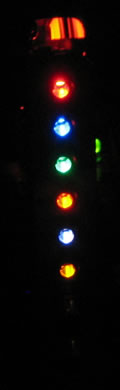

At the top of the card, there are three 4-pin headers for CD-In, Aux-In and MIDI.

At the bottom and bottom right, we can see the AV200 Audio processor and the various Dolby/DTS logos etched on the card:

3. Installation
The Asus Xonar D2 takes up one empty PCI slot. After installing and booting Windows, you will be prompted to install the drivers. Press cancel and use the Asus installer instead:

The driver installation procedure is simple, just keep pressing "Next >"

After rebooting, you are now ready to use your Asus Xonar D2 sound card. The control panel is simple but provides users with all the information and features:

Pressing the "Menu ^" button, you can configure various settings, like sample rate/channels,

mixer level settings for playback and recording,

environmental effects,

karaoke,

and FlexBass, which can boost the bass according to your setup.

The About Tab gives more info about the driver version


After we finished our tests, Asus provided an updated driver that fixed some of our initial problems with the sound quality.

- ASIO mode
The Asus Xonar D2 supports ASIO mode, at least with Windows XP and the driver pack that comes bulked with the retail package. For our tests, we used the latest version of Virtual DJ which worked without any problems:

The ASIO bit-depth can be set to either 16 or 24-bit.

While Latency can go from 2ms~300ms. Obviously, 2ms is the lowest and best setting.

4. Utilities
Asus also includes the Asus PMP and several trial versions of well known sound authoring software (Ableton Live Lite and Cakewalk Production Plus Pack (SONAR LE, Dimension LE, and Project5 LE). The Asus PMP (Portable Music Processor utility) can backup digital music content or CD audio into regular MP3/WMA files with Dolby Headphone, Dolby Virtual Speaker (w/ Pro-Logic II), and Smart Volume Normalization processing.

An MP3 encoder is not installed by default, but you can download a freeware package as prompted by the software:


The main interface of the Asus PMP is easy to navigate through and understand. Its main purpose is to convert Audio files (WMA <-> MP3), which it does very fast, using the Asus CPU AV200.

In addition, you can add several effects like Smart Volume normalization or Dolby effects:


We ran a quick conversion test. We selected one Mp3 file and decided to convert it to WMA 320Kbps:

Asus PMP prompts us that it will "freeze" all sound card operations:

The encoding started, and for a 7.09 minutes in length MP3 file, the conversion to WMA took only 12 seconds!

The version we installed was the latest:

5. Test Configuration
In order to test the Asus Xonar D2, we used RightMark Audio Analyzer.
RMAA suite is designed for testing the quality of analog and digital paths of any audio devices, be it a sound card, an MP3 player, a consumer CD/DVD player or an acoustic set. The results are obtained by playing and recording test signals passed through the tested audio path by means of frequency analysis algorithms. A more common mark is also provided for those unfamiliar with measured technical parameters.
For our tests, we used the latest version, v6.0.5.

The new version is the result of two years of development by the best experts in digital audio. RMAA 6.0 raises the bar of comfort and functionality for spectrum analyzers. That's why it is a program of choice for enthusiasts, professionals, and audio magazines around the world; and some manufacturers are developing new devices with the mandatory testing of their quality in RMAA. In short, the program at the moment is a de-facto standard providing quick and easy measurement of technical parameters, without the need to spend tens of thousands of dollars on specialized measurement systems.

For all our tests we used the following system:
- Motherboard: Asus P5K3 Deluxe (0703 Bios)
- CPU: Intel E6600
- HDD: WD 80JB
- Operating system: Windows XP SP2 with all the latest updates installed
- DirectX August 2007 revision
We also took measurements for the on-board sound card on the Asus P5K3 Deluxe motherboard, which is based on the SoundMax AL1988 chipset. This should be a good comparison, to see how the internal sound card compares against a dedicated sound card.
The testing methodology is explained in the RightMark Audio software. In short, we used an external cable to connect the output of the sound card to the input (line). The RMAA software generates signals that afterwards are recorded and analyzed. Moreover, the Asus Xonar D2 allows "internal" recording, using the "ALT" record channel, meaning it performs digitizing without external cabling. Therefore, we have two sets of tests, one with the external cable and one in internal mode.
For each mode we changed the sample rate and set all options as follows:

6. Test Results 16bit
For the first test, we set the internal sampling rate at 16bit with 44.1KHz (CD quality). Below are the test results for both Internal and External modes. We don't see a lot of difference:
RMAA v6.0.5 Results |
| Testing 16bit/44.1KHz |
|
|
Ratings |
| Frequency response (from 40 Hz to 15 kHz), dB |
+0.05, -0.04 |
+0.05, -0.04 |
Excellent |
| Noise level, dB (A) |
-96.3 |
-98.5 |
Excellent |
| Dynamic range, dB (A) |
96.5 |
96.7 |
Excellent |
| THD, % |
0.0005 |
0.0005 |
Excellent |
| THD + Noise, dB (A) |
-90.2 |
-90.4 |
Very good |
| IMD + Noise, % |
0.0042 |
0.0042 |
Excellent |
| Stereo crosstalk, dB |
-97.3 |
-96.3 |
Excellent |
| IMD at 10 kHz, % |
0.0045 |
0.0043 |
Excellent |
| General performance |
|
|
Excellent |
Proceeding to 16bit/48KHz we have:
RMAA v6.0.5 Results |
| Testing 16bit/48.0KHz |
|
|
Ratings |
| Frequency response (from 40 Hz to 15 kHz), dB |
+0.06, -0.04 |
+0.06, -0.04 |
Excellent |
| Noise level, dB (A) |
-97.0 |
-96.7 |
Excellent |
| Dynamic range, dB (A) |
97.0 |
97.3 |
Excellent |
| THD, % |
0.0006 |
0.0005 |
Excellent |
| THD + Noise, dB (A) |
-90.9 |
-91.1 |
Very good |
| IMD + Noise, % |
0.0039 |
0.0038 |
Excellent |
| Stereo crosstalk, dB |
-96.8 |
-97.8 |
Excellent |
| IMD at 10 kHz, % |
0.0041 |
0.0040 |
Excellent |
| General performance |
|
|
Excellent |
Again no major differences, even at 16bit/96KHz.
RMAA v6.0.5 Results |
| Testing 16bit/96.0KHz |
|
|
Ratings |
| Frequency response (from 40 Hz to 15 kHz), dB |
+0.07, -0.05 |
+0.08, -0.05 |
Excellent |
| Noise level, dB (A) |
-99.7 |
-100.3 |
Excellent |
| Dynamic range, dB (A) |
100.1 |
100.3 |
Excellent |
| THD, % |
0.0008 |
0.0007 |
Excellent |
| THD + Noise, dB (A) |
-93.2 |
-93.4 |
Very good |
| IMD + Noise, % |
0.0028 |
0.0027 |
Excellent |
| Stereo crosstalk, dB |
-98.8 |
-98.1 |
Excellent |
| IMD at 10 kHz, % |
0.0030 |
0.0029 |
Excellent |
| General performance |
|
|
Excellent |
Lastly, the highest recording level is 16bit/192KHz.
RMAA v6.0.5 Results |
| Testing 16bit/192.0KHz |
|
|
Ratings |
| Frequency response (from 40 Hz to 15 kHz), dB |
+0.08, -0.05 |
+0.08, -0.05 |
Excellent |
| Noise level, dB (A) |
-103.0 |
-103.3 |
Excellent |
| Dynamic range, dB (A) |
103.0 |
103.2 |
Excellent |
| THD, % |
0.0013 |
0.0013 |
Excellent |
| THD + Noise, dB (A) |
-93.2 |
-93.3 |
Very good |
| IMD + Noise, % |
0.0023 |
0.0022 |
Excellent |
| Stereo crosstalk, dB |
-99.9 |
-101.0 |
Excellent |
| IMD at 10 kHz, % |
0.0025 |
0.0025 |
Excellent |
| General performance |
|
|
Excellent |
Below is a table that lists all the test results from "Internal" recording mode.

7. Test Results 24bit
At 24bit/44KHz, we got the following RMAA results:
RMAA v6.0.5 Results |
| Testing 24bit/44.1KHz |
|
|
Ratings |
| Frequency response (from 40 Hz to 15 kHz), dB |
+0.05, -0.04 |
+0.05, -0.04 |
Excellent |
| Noise level, dB (A) |
-108.3 |
-100.2 |
Excellent |
| Dynamic range, dB (A) |
108.3 |
101.4 |
Excellent |
| THD, % |
0.0004 |
0.0004 |
Excellent |
| THD + Noise, dB (A) |
-99.5 |
-93.9 |
Very good |
| IMD + Noise, % |
0.0014 |
0.0046 |
Excellent |
| Stereo crosstalk, dB |
-110.5 |
-98.5 |
Excellent |
| IMD at 10 kHz, % |
0.0016 |
0.0047 |
Excellent |
| General performance |
|
|
Excellent |
With 24bit, we started to see some differences in performance, between the Internal/External recording modes, especially in IMD +Noise levels and Stereo crosstalk:
RMAA v6.0.5 Results |
| Testing 24bit/48.0KHz |
|
|
Ratings |
| Frequency response (from 40 Hz to 15 kHz), dB |
+0.06, -0.04 |
+0.06, -0.04 |
Excellent |
| Noise level, dB (A) |
-117.2 |
-98.0 |
Excellent |
| Dynamic range, dB (A) |
117.2 |
97.5 |
Excellent |
| THD, % |
0.0004 |
0.0006 |
Excellent |
| THD + Noise, dB (A) |
-103.5 |
-91.4 |
Excellent |
| IMD + Noise, % |
0.0006 |
0.0034 |
Excellent |
| Stereo crosstalk, dB |
-116.6 |
-96.1 |
Excellent |
| IMD at 10 kHz, % |
0.0006 |
0.0025 |
Excellent |
| General performance |
|
|
Excellent |
Much greater differences in this mode, just look at the Noise level and Dynamic range.
RMAA v6.0.5 Results |
| Testing 24bit/96.0KHz |
|
|
Ratings |
| Frequency response (from 40 Hz to 15 kHz), dB |
+0.08, -0.05 |
+0.08, -0.05 |
Excellent |
| Noise level, dB (A) |
-117.2 |
-100.4 |
Excellent |
| Dynamic range, dB (A) |
117.1 |
95.1 |
Excellent |
| THD, % |
0.0007 |
0.0014 |
Excellent |
| THD + Noise, dB (A) |
-100.4 |
-82.3 |
Good |
| IMD + Noise, % |
0.0007 |
0.012 |
Very good |
| Stereo crosstalk, dB |
-115.3 |
-91.8 |
Excellent |
| IMD at 10 kHz, % |
0.0009 |
0.0080 |
Excellent |
| General performance |
|
|
Excellent |
Lastly, at the best quality recording you can get, at 24bit/192KHz, with RMAA:
RMAA v6.0.5 Results |
| Testing 24bit/192.0KHz |
|
|
Ratings |
| Frequency response (from 40 Hz to 15 kHz), dB |
+0.08, -0.05 |
+0.08, -0.05 |
Excellent |
| Noise level, dB (A) |
-116.3 |
-99.0 |
Excellent |
| Dynamic range, dB (A) |
116.3 |
116.2 |
Excellent |
| THD, % |
0.0013 |
0.0013 |
Excellent |
| THD + Noise, dB (A) |
-95.3 |
-95.3 |
Excellent |
| IMD + Noise, % |
0.0012 |
0.0012 |
Excellent |
| Stereo crosstalk, dB |
-112.5 |
-105.3 |
Excellent |
| IMD at 10 kHz, % |
0.0015 |
0.0039 |
Excellent |
| General performance |
|
|
Excellent |
Again, there are differences between the Internal and External recording modes. As we suspected, Internal recording method is preferable since the signal is recorded digitally from the card's chipsets.
Below is a table with all the performance results for the various 24bit modes:

8. Comparison Tests 16bit
An important question is whether the Asus Xonar D2 offers any improvements, compared with the on-board soundcard. For that purpose, we used the external recording mode on both the Asus Xonar D2 and the SoundMax HD Audio sound cards (3.5mm jack male-to-male).
Starting from CD quality, we see a clear advantage in the Asus Xonar D2 in the Noise/Dynamic Range, and of course THD scores :
| RMAA v6.0.5 Comparison Test Results |
| Testing 16bit/44.10KHz |
ASUS Xonar D2 Audio |
SoundMAX HD Audio |
| Frequency response (from 40 Hz to 15 kHz), dB: |
+0.05, -0.04 |
+0.26, -0.07 |
| Noise level, dB (A): |
-96.3 |
-88.8 |
| Dynamic range, dB (A): |
96.5 |
87.4 |
| THD, %: |
0.0005 |
0.0092 |
| IMD + Noise, %: |
0.0042 |
0.047 |
| Stereo crosstalk, dB: |
-97.3 |
-88.9 |
| RMAA v6.0.5 Comparison Test Results |
| Testing 16bit/48.0KHz |
ASUS Xonar D2 Audio |
SoundMAX HD Audio |
| Frequency response (from 40 Hz to 15 kHz), dB: |
+0.06, -0.04 |
+0.11, -0.03 |
| Noise level, dB (A): |
-97.0 |
-88.7 |
| Dynamic range, dB (A): |
97.0 |
87.7 |
| THD, %: |
0.0006 |
0.0092 |
| IMD + Noise, %: |
0.0039 |
0.015 |
| Stereo crosstalk, dB: |
-96.8 |
-87.7 |
| RMAA v6.0.5 Comparison Test Results |
| Testing 16bit/96.0KHz |
ASUS Xonar D2 Audio |
SoundMAX HD Audio |
| Frequency response (from 40 Hz to 15 kHz), dB: |
+0.07, -0.05 |
+0.02, -0.06 |
| Noise level, dB (A): |
-99.7 |
-88.8 |
| Dynamic range, dB (A): |
100.1 |
87.7 |
| THD, %: |
0.0008 |
0.0091 |
| IMD + Noise, %: |
0.0028 |
0.014 |
| Stereo crosstalk, dB: |
-98.8 |
-85.4 |
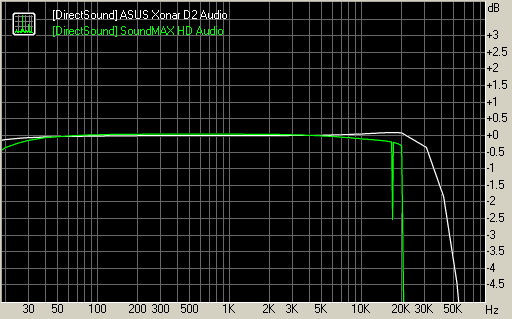
At the best quality for 16bit, the performance differences are even clearer:
| RMAA v6.0.5 Comparison Test Results |
| Testing 16bit/192.0KHz |
ASUS Xonar D2 Audio |
SoundMAX HD Audio |
| Frequency response (from 40 Hz to 15 kHz), dB: |
+0.08, -0.05 |
+0.04, -0.17 |
| Noise level, dB (A): |
-103.0 |
-89.0 |
| Dynamic range, dB (A): |
103.0 |
87.8 |
| THD, %: |
0.0013 |
0.0092 |
| IMD + Noise, %: |
0.0023 |
0.014 |
| Stereo crosstalk, dB: |
-99.9 |
-84.1 |
And the following graphs show the differences:
Frequency response graph
Noise level graph

Dynamic range

Intermodulation distortion graph
THD + Noise (at -3 dB FS) graph:

9. Comparison Tests 24bit
After the 16bit tests, we proceed to the 24bit tests with the same methodology. We expect to see important differences here, since 24bits is more demanding:
| RMAA v6.0.5 Comparison Test Results |
| Testing 24bit/44.1KHz |
ASUS Xonar D2 Audio |
SoundMAX HD Audio |
| Frequency response (from 40 Hz to 15 kHz), dB: |
+0.05, -0.04 |
+0.26, -0.07 |
| Noise level, dB (A): |
-108.3 |
-89.2 |
| Dynamic range, dB (A): |
108.3 |
88.8 |
| THD, %: |
0.0004 |
0.0096 |
| IMD + Noise, %: |
0.0014 |
0.047 |
| Stereo crosstalk, dB: |
-110.5 |
-87.8 |
| RMAA v6.0.5 Comparison Test Results |
| Testing 24bit/48.0KHz |
ASUS Xonar D2 Audio |
SoundMAX HD Audio |
| Frequency response (from 40 Hz to 15 kHz), dB: |
+0.06, -0.04 |
+0.11, -0.03 |
| Noise level, dB (A): |
-117.2 |
-89.3 |
| Dynamic range, dB (A): |
117.2 |
88.9 |
| THD, %: |
0.0004 |
0.0092 |
| IMD + Noise, %: |
0.0006 |
0.014 |
| Stereo crosstalk, dB: |
-116.6 |
-88.5 |
| RMAA v6.0.5 Comparison Test Results |
| Testing 24bit/96.0KHz |
ASUS Xonar D2 Audio |
SoundMAX HD Audio |
| Frequency response (from 40 Hz to 15 kHz), dB: |
+0.08, -0.05 |
+0.02, -0.06 |
| Noise level, dB (A): |
-117.2 |
-89.5 |
| Dynamic range, dB (A): |
117.1 |
89.1 |
| THD, %: |
0.0007 |
0.0093 |
| IMD + Noise, %: |
0.0007 |
0.014 |
| Stereo crosstalk, dB: |
-115.3 |
-85.9 |
At the best recording quality, the differences are significant:
| RMAA v6.0.5 Comparison Test Results |
| Testing 24bit/192.0KHz |
ASUS Xonar D2 Audio |
SoundMAX HD Audio |
| Frequency response (from 40 Hz to 15 kHz), dB: |
+0.08, -0.05 |
+0.04, -0.17 |
| Noise level, dB (A): |
-116.3 |
-89.4 |
| Dynamic range, dB (A): |
116.3 |
89.1 |
| THD, %: |
0.0013 |
0.0091 |
| IMD + Noise, %: |
0.0012 |
0.014 |
| Stereo crosstalk, dB: |
-112.5 |
-85.3 |
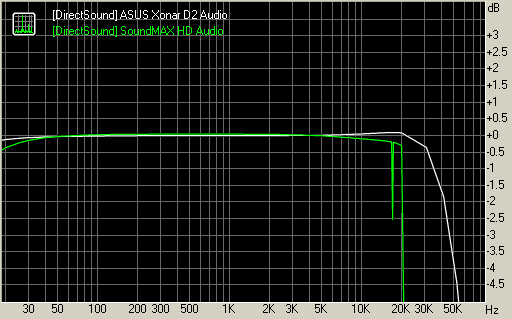
Looking at the Noise Level, we see a difference of 26.9dB! The TDH% levels are much better than what the SoundMAX HD Audio chipset can offer:
Frequency response graph
Noise level graph

Dynamic range

Intermodulation distortion graph

THD + Noise (at -3 dB FS) graph:

10. Conclusion
Asus' first attempt in the sound card arena comes in the form of the "Xonar D2". The model comes either in PCI or PCI-E support. In our review, we examined the Xonar D2 PCI version. The ASUS Xonar D2 features a signal- to-noise ratio (SNR) of 118 db for both audio in and out and for all 7.1 channels. Pretty impressive numbers if you ask me.
The Asus Xonar D2 has a good retail package. The drivers work and ASIO mode didn't present any problems. The included Asus PMP software will encode WMA/MP3 files at blazing fast speeds and there are Ableton Live! Lite and several Cakewalk software packages bulked in. Of course, power users will prefer the full retail versions, but they come at a price.
The design of the card is very good. All outputs light up, which can look quite impressive under night conditions, although we didn't find the particular feature very useful. What we noticed is that the card runs very hot, with the external metal shell working like a cooler. There are many cables included in the retail package.

After running several with RightMark Audio Analyzer and in comparison with the on-board sound card of the Asus P5K3 Deluxe (SoundMax based), we saw that the Asus Xonar D2 was much better in all possible bitrates and frequencies. The card had much lower noise and better dynamic range. The recent driver update solved some issues we had with the driver that comes with the driver CD. The card now gets an "Excellent" rating in almost all RightMark Audio Analyzer 6.0.5 tests, whether in 16 or 24 bits.
Unfortunately, we didn't have in our labs other PCI based sound cards to examine and directly compare against. Despite the fact that the RightMark Audio Analyzer gives some indication, professional users will test the card's limits and strengths under real life applications. The card supports ASIO and several Dolby Digital modes which are useful for gamers also. EAX2.0 support is present, but it doesn't support EAX HD mode, only the latest Creative Labs cards support this mode.
Concluding this review, we are not very sure whether we should or should not recommend this sound card to anyone. Before jumping to any conclusions, let me explain. The Asus Xonar D2 costs somewhere in the vicinity of €170. Most currently sold motherboards already have on-board Audio chipsets that support HD content. Ordinary users will most probably not "hear the difference", especially with 2 speaker setups. I assume that 5.1 or even 7.1 users that have spent more money on speakers will hear a difference, since the Asus Xonar D2 has much lower noise than on-board Audio chipsets. But if you can afford the €170, give the Asus Xonar D2 a look.
For the more professional users, there are a number of other options, either from Creative Labs or some very respectable companies in the field like M-Audio, Terratec, Roland, ESI, et al. But since we haven't tested any other cards, we cannot be sure about their comparative performance. :-)
Positive
- Very good external design
- All input ports are backlit
- Full support with WDM and ASIO drivers
- Included Asus PMP encodes blazing fast to WMA/MP3
- Fully Dolby certified sound card
- Windows control panel looks stable and complete
- ASIO drivers have low, 2ms latency
- No major problems detected during our tests, very stable
- Very good-to-Excellent test results with RMAA testing suite
- Complete retail package with many cables and MIDI daughter card
Negative
- High retail price
- Black metallic shell on the card runs very HOT