
Toshiba Develops New Energy-Saving Flip-Flop Circuit
Toshiba will present a new power eficient flip-flop circuit for mobile equipment at t the 2011 IEEE International Solid-State Circuits Conference (ISSCC).
The new flip-flop circuit has been developed using the 40nm CMOS process is is expected to reduce power consumption in mobile equipment. Measured data verifies that the power dissipation of the new flip-flop is up to 77% less than that of a typical conventional flip-flop and that it achieves a 24% reduction in total power consumption when applied to a wireless LAN chip.
Measured data verifies that the power dissipation of the new flip-flop is up to 77% less than that of a typical conventional flip-flop and that it achieves a 24% reduction in total power consumption when applied to a wireless LAN chip.
A flip-flop is a circuit that temporarily stores one bit of data during arithmetic processing by a digital system-on-a-chip (SoC) incorporated in mobile equipment and other digital equipment. As a typical SoC uses 100,000 to 10 million flip-flops they are an essential part of an SoC design.
A typical flip-flop incorporates a clock buffer to produce a clock inverted signal required for the circuit's operation. When triggered by a signal from the clock, the clock buffer consumes power, even when the data is unchanged. In order to reduce this power dissipation, a power-saving design technique called clock gating is widely used to cut delivery of the clock signal to unused blocks. However, after applying the clock gating, the flip-flop active rate, a measure of data change rate per clock, is only 5-15%, indicating that there is still plenty of room for further power reduction.
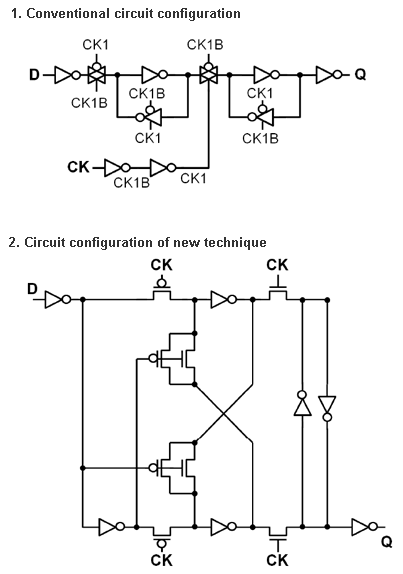
In order to save power, Toshiba changed the structure of the typical flip-flop and eliminated the power-consuming clock buffer. This approach brings with it the problem of data collision between the data writing circuitry and the state holding circuitry in the flip-flop, which Toshiba overcame by adding adaptive coupling circuitry to the flip-flop. A combination of an nMOS transistor and a pMOS transistor, this circuitry adaptively weakens state-retention coupling and prevents collisions. Despite the addition of the adaptive coupling circuitry, overall simplification of the basic flip-flop configuration reduces the transistor count from 24 to 22, and the cell area is less than that of the conventional flip-flop.
This achievement will be announced on February 23 at the 2011 IEEE International Solid-State Circuits Conference (ISSCC) now being held in the United States.
Measured data verifies that the power dissipation of the new flip-flop is up to 77% less than that of a typical conventional flip-flop and that it achieves a 24% reduction in total power consumption when applied to a wireless LAN chip.
A flip-flop is a circuit that temporarily stores one bit of data during arithmetic processing by a digital system-on-a-chip (SoC) incorporated in mobile equipment and other digital equipment. As a typical SoC uses 100,000 to 10 million flip-flops they are an essential part of an SoC design.
A typical flip-flop incorporates a clock buffer to produce a clock inverted signal required for the circuit's operation. When triggered by a signal from the clock, the clock buffer consumes power, even when the data is unchanged. In order to reduce this power dissipation, a power-saving design technique called clock gating is widely used to cut delivery of the clock signal to unused blocks. However, after applying the clock gating, the flip-flop active rate, a measure of data change rate per clock, is only 5-15%, indicating that there is still plenty of room for further power reduction.
In order to save power, Toshiba changed the structure of the typical flip-flop and eliminated the power-consuming clock buffer. This approach brings with it the problem of data collision between the data writing circuitry and the state holding circuitry in the flip-flop, which Toshiba overcame by adding adaptive coupling circuitry to the flip-flop. A combination of an nMOS transistor and a pMOS transistor, this circuitry adaptively weakens state-retention coupling and prevents collisions. Despite the addition of the adaptive coupling circuitry, overall simplification of the basic flip-flop configuration reduces the transistor count from 24 to 22, and the cell area is less than that of the conventional flip-flop.
This achievement will be announced on February 23 at the 2011 IEEE International Solid-State Circuits Conference (ISSCC) now being held in the United States.