Sharp Improves MBE-grown Blue Laser Performance
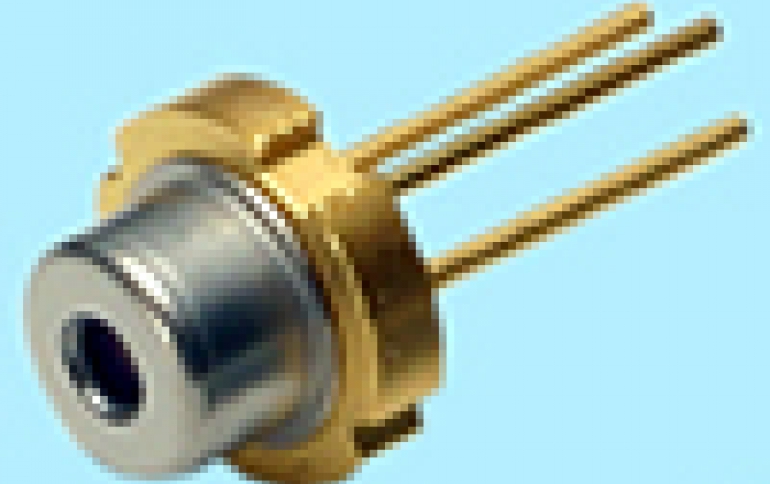
Engineers at Sharp's research laboratory in the UK have fabricated the first continuous-wave InGaN-based laser diodes to be grown by MBE.
All commercial blue-violet laser diodes are grown by MOCVD currently, but early last
year Jon Heffernan and colleagues at Sharp Laboratories Europe produced 405 nm diodes
using MBE for the first time.
One key advantage of the MBE method is its much lower consumption of source materials for device growth, in particular the amount of ammonia required as the source of nitrogen.
However, those initial devices only worked in pulsed mode and had a very high threshold current. To be used commercially, the lasers need to work continuously and at sufficient power to read data on optical discs.
"This result confirms that MBE is a viable growth method for nitride lasers," said Heffernan. "Sharp is now in the unique position of having both MBE and MOCVD technologies available."
At room temperature, the Sharp team?s latest lasers emitted around 0.2 mW for three minutes before burning out. The continuous-wave threshold current was 125 mA, corresponding to a threshold current density of 5.7 kAcm-2, reports the team in the June 23 issue of the journal Electronics Letters.
Heffernan and colleagues made the lasers on n-type GaN substrates supplied by Sumitomo Electric Industries. The active laser region included three undoped 3 nm-thick InGaN quantum wells with 10% indium fraction.
During the three minutes that the lasers worked for, there was a variation of around 6 nm about the crucial emission wavelength of 405 nm.
Growing the lasers by MBE rather by MOCVD promises to lower manufacturing costs by reducing the consumption of ammonia gas, which provides the nitrogen content in the devices.
However, Heffernan and colleagues still have a lot of development work to do before the MBE method can be considered suitable for mass production. The team will now concentrate on improving device operating characteristics by optimizing p-type doping in the AlGaN cladding region and reducing the growth temperature, which should increase the lifetime of the devices.
Significantly, the European laboratory's parent company already uses MBE in mass production of lasers. At its Mihara fabrication facility in Hiroshima, Sharp manufactures a large proportion of the world's red lasers that are used in DVD applications.
Sharp is also part of the Blu-ray Disc Association, along with potential blue laser manufacturers Nichia, Sony and Matsushita Electric.
One key advantage of the MBE method is its much lower consumption of source materials for device growth, in particular the amount of ammonia required as the source of nitrogen.
However, those initial devices only worked in pulsed mode and had a very high threshold current. To be used commercially, the lasers need to work continuously and at sufficient power to read data on optical discs.
"This result confirms that MBE is a viable growth method for nitride lasers," said Heffernan. "Sharp is now in the unique position of having both MBE and MOCVD technologies available."
At room temperature, the Sharp team?s latest lasers emitted around 0.2 mW for three minutes before burning out. The continuous-wave threshold current was 125 mA, corresponding to a threshold current density of 5.7 kAcm-2, reports the team in the June 23 issue of the journal Electronics Letters.
Heffernan and colleagues made the lasers on n-type GaN substrates supplied by Sumitomo Electric Industries. The active laser region included three undoped 3 nm-thick InGaN quantum wells with 10% indium fraction.
During the three minutes that the lasers worked for, there was a variation of around 6 nm about the crucial emission wavelength of 405 nm.
Growing the lasers by MBE rather by MOCVD promises to lower manufacturing costs by reducing the consumption of ammonia gas, which provides the nitrogen content in the devices.
However, Heffernan and colleagues still have a lot of development work to do before the MBE method can be considered suitable for mass production. The team will now concentrate on improving device operating characteristics by optimizing p-type doping in the AlGaN cladding region and reducing the growth temperature, which should increase the lifetime of the devices.
Significantly, the European laboratory's parent company already uses MBE in mass production of lasers. At its Mihara fabrication facility in Hiroshima, Sharp manufactures a large proportion of the world's red lasers that are used in DVD applications.
Sharp is also part of the Blu-ray Disc Association, along with potential blue laser manufacturers Nichia, Sony and Matsushita Electric.