MRAM memory: Is it the future?
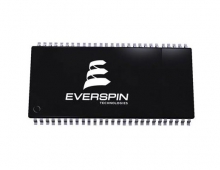
Following the announcement from Fujitsu-Epson about the development of FRAM memory technology, Toshiba and NEC announced today that they have made progress in the development of MRAM; another promising technology for making non-volatile memory based on magnetism.
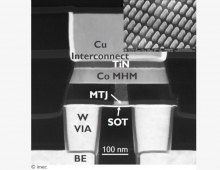
MRAM is a method of storing data bits using magnetic charges instead of the
electrical charges used by DRAM (dynamic random access memory). Scientists define a
metal as magnetoresistive if it shows a slight change in electrical resistance when
placed in a magnetic field.
The advantages of MRAM over DRAM is that the first requires far less memory refreshes than DRAM - leading to better power consumption. It is also speed-competitive with SRAM (the cpu CACHE memory). So MRAM can amount to more storage in mobile devices, with longer battery life. In addition, MRAM retains data after a power supply is turned off. Replacing DRAM with MRAM could prevent data loss and also mean computers that start instantly, without waiting for software to boot up.
Toshiba and NEC developed a new magnetic material that amplifies the magnetic coupling between the recording layers used in MRAM. According to the companies, the new material improves the magneto-electric characteristics of the MRAM, meaning it requires less current to operate.
New memory technologies are already becoming established. Over the next 12 to 18 months there will be some very different types of devices emerging with embedded non-volatile storage that will provide the designer with very interesting options.
Part of the move to the new technologies is that the existing non-volatile memory - flash EPROM - is set to face some major challenges over the next few years.
Flash has been the mainstay of silicon-based non-volatile storage for the past 15 years, used in most applications from industrial to mobile phones. The problem is that as silicon technology advances, the problem of programming and reliability of flash increases.
Flash is based on electrons tunnelling through a barrier, and as voltages get lower, the programming time gets longer which is already relatively high at several milliseconds. Reducing the thickness of the barrier helps, but that increases problems with breakdown that can reduce reliability. All this is coupled with the fact that flash never had a very good lifetime anyway - typically around 100000 read and write cycles.
So new, truly non volatile technologies are coming through with write times equivalent to today's volatile memories such as SRAM, and lifetimes of a million times more cycles.
With the latest silicon manufacturing processes, the memories - magnetic RAM (MRAM) and ferroelectric RAM (FRAM) - are starting to have enough capacity to be useful.
Ferroelectric RAM has been around for as long as MRAM and is already commercially viable.
Although both MRAM and FRAM technologies attempt to create a true non volatile random access memory, the underlying technologies are totally different. FRAM memory is based on charge while MRAM uses the magnetic properties of materials.
FRAM uses PZT - an alloy of lead, zirconium and titanium - that acts like a capacitor to store the data.
Samsung, now the world's largest memory chip maker, is also a licensee and has talked about manufacturing stand alone memories, but development has been slow.
US chip giant Texas Instruments has also licensed the Ramtron technology and like Motorola, is looking to jump to the 90nm process technology to embed the memories in devices such as digital signal processors. It did a comprehensive evaluation of next generation memories several years ago and came to the conclusion that FRAM was the best choice as it is easily scaleable to 90nm.
MRAM will eventually be made in high densities, and will perhaps replace your computer's HD - leading to a fast computer that can be instantly turned on. If all goes well, MRAM might reach high densities required to compete against FLASH in cellphones and other devices by 2007.
On the other hand, FRAM can be considered a good competitor in niche applications, mainly smart cards and RF tags.
So there is a "battle" here. However, flash is not about to give up and die, and there are various approaches such as storing multiple bits in each cell that extends the lifetime of the flash. It is well established, well known and cost effective, and will take a lot to shake out.
The advantages of MRAM over DRAM is that the first requires far less memory refreshes than DRAM - leading to better power consumption. It is also speed-competitive with SRAM (the cpu CACHE memory). So MRAM can amount to more storage in mobile devices, with longer battery life. In addition, MRAM retains data after a power supply is turned off. Replacing DRAM with MRAM could prevent data loss and also mean computers that start instantly, without waiting for software to boot up.
Toshiba and NEC developed a new magnetic material that amplifies the magnetic coupling between the recording layers used in MRAM. According to the companies, the new material improves the magneto-electric characteristics of the MRAM, meaning it requires less current to operate.
New memory technologies are already becoming established. Over the next 12 to 18 months there will be some very different types of devices emerging with embedded non-volatile storage that will provide the designer with very interesting options.
Part of the move to the new technologies is that the existing non-volatile memory - flash EPROM - is set to face some major challenges over the next few years.
Flash has been the mainstay of silicon-based non-volatile storage for the past 15 years, used in most applications from industrial to mobile phones. The problem is that as silicon technology advances, the problem of programming and reliability of flash increases.
Flash is based on electrons tunnelling through a barrier, and as voltages get lower, the programming time gets longer which is already relatively high at several milliseconds. Reducing the thickness of the barrier helps, but that increases problems with breakdown that can reduce reliability. All this is coupled with the fact that flash never had a very good lifetime anyway - typically around 100000 read and write cycles.
So new, truly non volatile technologies are coming through with write times equivalent to today's volatile memories such as SRAM, and lifetimes of a million times more cycles.
With the latest silicon manufacturing processes, the memories - magnetic RAM (MRAM) and ferroelectric RAM (FRAM) - are starting to have enough capacity to be useful.
Ferroelectric RAM has been around for as long as MRAM and is already commercially viable.
Although both MRAM and FRAM technologies attempt to create a true non volatile random access memory, the underlying technologies are totally different. FRAM memory is based on charge while MRAM uses the magnetic properties of materials.
FRAM uses PZT - an alloy of lead, zirconium and titanium - that acts like a capacitor to store the data.
Samsung, now the world's largest memory chip maker, is also a licensee and has talked about manufacturing stand alone memories, but development has been slow.
US chip giant Texas Instruments has also licensed the Ramtron technology and like Motorola, is looking to jump to the 90nm process technology to embed the memories in devices such as digital signal processors. It did a comprehensive evaluation of next generation memories several years ago and came to the conclusion that FRAM was the best choice as it is easily scaleable to 90nm.
MRAM will eventually be made in high densities, and will perhaps replace your computer's HD - leading to a fast computer that can be instantly turned on. If all goes well, MRAM might reach high densities required to compete against FLASH in cellphones and other devices by 2007.
On the other hand, FRAM can be considered a good competitor in niche applications, mainly smart cards and RF tags.
So there is a "battle" here. However, flash is not about to give up and die, and there are various approaches such as storing multiple bits in each cell that extends the lifetime of the flash. It is well established, well known and cost effective, and will take a lot to shake out.